Episodes

  • Can AI Understand Beauty?
    Jul 8 2026

    Can an algorithm tell you what is beautiful? And if it can, whose idea of beauty is it working from?

    This week's guest is Hugo, founder of London's first AI consultancy. He has trained foundation models, audited machine vision systems for The Times and Vogue Business, and taught over 5,000 teenagers to build and ship real products through his company Sherpas. He now runs AI Night School, helping leaders understand what this technology actually does.

    The conversation runs from his first business at six years old, selling potpourri to golfers, to the project that tried to teach a machine to recognise beauty, and what that project quietly exposed. AI does not fix our instincts. It amplifies them. Every bias we have not questioned gets handed back to us, faster and with a confidence it has not earned.

    We also get into creativity, the discipline of protecting your focus, and the ethics of building technology that shapes how people see themselves and their own worth.

    Listen now on Spotify, Apple Podcasts and YouTube.

    Show More Show Less
    50 mins
  • More Visible as a Man: It Was Never a Glitch
    Jul 1 2026

    Swap a woman's name for a man's on the same profile, and the visibility climbs. Amazon's hiring algorithm learned to filter out the word "women's" without anyone telling it to. None of this is a fault in an otherwise fair system. It is the system, running on exactly what it was trained on.


    This week Leah Garrett and Jenny Garrett OBE are joined by Cecilia Jastrzembska, a senior policy advisor and one of the clearest voices on algorithmic accountability in the UK. Cecilia has campaigned to make misogyny a hate crime and works where political journalism, public policy and advocacy meet. Her argument runs against the comfortable version of this conversation: bias in AI is structural, not a series of unlucky accidents, and designing for accountability has become a strategic necessity rather than a moral footnote. We get into the recruitment tools quietly deciding who gets hired, the LinkedIn experiment that exposed how visibility shifts with gender, and why so many government consultations fail the people they are meant to serve. Underneath all of it sits one idea: legibility. Making these systems readable enough that the people they fail can challenge them.


    AI for Equity is hosted by Leah Garrett and Jenny Garrett OBE, exploring how technology deepens inequality and how it can be built to do the opposite.


    Cecilia Jastrzembska is a UK Government Senior Policy Advisor at Director Level. She founded European Movement Women and is a Co-Founding member of of Women In AI, UKAI, an Advocate for 50:50 Parliament, and nominee for the Outstanding Award for Tech Regulation by CogX as well as the UN Women UK Campaigner of the Year Award. A longstanding gender equality campaigner, Cecilia is an award winning global speaker and political journalist (LinkTree) published in over 25 international newspapers. Through these positions as well as central government, she has worked with, spoken alongside, organised and chaired panel events and roundtables with over 200 MPs, MEPs, diplomats, NGO representatives and international legal experts on ending (M)VAWG, mitigating the climate crisis and ethical AI.

    Show More Show Less
    49 mins
  • Toxic by Design: How AI Surfaces the Risks Organisations Would Rather Not Name
    Jun 24 2026

    We tend to treat toxic workplaces as accidents. Jody, founder of Gentia, argues they are closer to design, and that the psychosocial hazards doing the most damage are the ones organisations are least willing to name.

    In this episode we talk about what psychosocial hazards actually are, from crushing workloads and bullying to poor leadership and the slow loss of autonomy, and why they so rarely show up in standard engagement data. Jodie shares what she learned across more than a decade in workplace wellbeing, how helping build one of Australia's largest early education providers shaped her understanding of who pays the price for bad culture, and how Gentia uses AI to make hidden risk measurable, and therefore actionable.

    A conversation about leadership, accountability, and the difference between saying you care about wellbeing and being willing to look at the evidence.

    AI for Equity is hosted by Leah Garrett and Jenny Garrett OBE.


    Jody Warren – Bio

    Jody is the Co-Founder of Gentia and a long-time advocate for workplaces that help people thrive, not just survive. She believes work should leave people better off, not depleted, and has spent her career designing the systems that make that possible.

    Before Gentia, Jody co-founded Australia's largest corporate early education group, driven by a mission to help more women return to the workforce. Running that business revealed a powerful truth: how people experience work shapes how they show up everywhere else.

    That insight led her into psychological safety at work, the conditions that determine whether people are protected from harm like burnout, bullying, and chronic stress, or quietly damaged by them. She spent more than a decade learning what actually keeps people safe and well at work, and who pays the price when organisations get it wrong.

    Now she's encoding that expertise into AI. Gentia is a platform that helps organisations protect their people from the hidden risks at work that quietly cause harm, things like burnout, bullying, and chronic stress. Most AI in this space guesses from survey data. Gentia is built the other way around, with deep human expertise encoded in first, so it can see these risks precisely, explain them clearly, and help organisations act on them before people get hurt.

    Show More Show Less
    52 mins
  • Mindset, Method, Means: How to Implement AI Without Losing the People
    Jun 17 2026

    What does it take to bring AI into a team without losing the people inside it?

    In this episode of AI for Equity, we're joined by Richard De Villiers, a facilitator and consultant who helps organisations rethink collaboration in remote and hybrid settings. With a background spanning IT and HR, Richard works at the meeting point of people, process, and technology, and he has strong views on getting that order right.

    We talk through his mindset, method, and means framework: building a culture that can absorb change, designing clear processes for how AI actually gets used, and making sure the tools are accessible enough that nobody feels left behind. Richard also makes the case for reframing AI as IA, the intelligent assistant, a shift that moves the technology from threat to support and changes who feels in control of it.

    Along the way we get into employee fear and why it deserves to be taken seriously rather than managed away, the difference between AI working in isolation and AI genuinely complementing human judgement, and why intentional design beats enthusiastic adoption every time.

    If you lead a team, sit on one, or are trying to work out what AI should and shouldn't touch in your organisation, this one is for you.

    Listen now, and let us know where you land on AI versus IA.

    Show More Show Less
    47 mins
  • What Happens When Talent Has No Guide? Mentorship, STEM and the Future of AI
    Jun 10 2026
    What Happens When Talent Has No Guide? Mentorship, STEM and the Future of AIIn this episode of AI for Equity, hosts Jenny Garrett OBE and Leah-Sunshine Garrett sit down with Bamidele Farinre, Chartered Biomedical Scientist, educator, author of The Mentor's Journey: From Learning to Leading, and passionate STEM advocate.Bamidele shares her remarkable journey from growing up in Nigeria with dreams of becoming a pharmacist, to overcoming academic setbacks after moving to the UK, and ultimately building a successful career in biomedical science, education and leadership.Bamidele Farinre is a Chartered Biomedical Scientist, STEM leader, Agile Project Manager, and advocate working at the intersection of science, technology, education, leadership, and social equity. Her work focuses on ensuring innovation, particularly in artificial intelligence, is developed responsibly, ethically, and inclusively.She is Vice Chair of the IBMS Virology Specialist Advisory Panel, an HCPC Biomedical Scientist International Registration Assessor, Fellow of the Institute of Biomedical Science, and Honorary Fellow of the Academy for Healthcare Science. Her proposal on AI equity in STEM was selected by the UK All-Party Parliamentary Group on Diversity and Inclusion in STEM and adopted into its 2026 to 2027 programme led by the British Science Association.Bamidele is also the founder of BAMS Space “No Ceiling,” a global mentorship and leadership platform supporting underrepresented communities in STEM. Through policy advocacy, speaking, writing, and mentorship, she continues to champion equitable access, representation, and ethical innovation across science and technology.Together, we explore:• The resilience required to overcome failure and setbacks• Why mentorship can be transformational rather than transactional• The barriers facing underrepresented groups in STEM• The role of advocacy in creating equitable opportunities• How representation shapes the future of AI• Bamidele's pioneering work on AI equity in STEM• Why inclusion must be built into innovation from the startThis conversation reminds us that talent is everywhere, but opportunity is not. If we want AI systems that serve everyone fairly, we must ensure that the people building and shaping those systems reflect the diversity of the communities they impact.Connect with Bamidele:IG: https://www.instagram.com/bamiciousofficial/LI: https://www.linkedin.com/in/bamidele-farinre-352b1191/TikTok:https://www.tiktok.com/@simply_bamsstem/video/7593421101628214550FB:https://www.facebook.com/bamiciousofficial/BAMS Space Newsletter: https://www.linkedin.com/newsletters/bams-space-no-ceiling-7208851946718330882/Relevant Featured Links:• https://www.linkedin.com/events/7457408514643197952/ • https://preciousonline.co.uk/bamidele-farinre-ai-equity-stem-policy/• https://thepathologist.com/issues/2026/articles/april/lets-banish-the-bias-in-ai-models/• https://www.selectscience.net/video/advancing-ai-equity-and-the-future-of-laboratory-governance-with-bamidele-farinre• https://www.linkedin.com/newsletters/bams-space-no-ceiling-7208851946718330882/• https://www.britishscienceassociation.org/news/appg-on-diversity-inclusion-in-stem-launches-new-project-on-ai-equity https://thebiomedicalscientist.net/2026/03/23/towards-fairer-ai-future-stem• https://ahcs.ac.uk/2026/03/13/ahcs-honorary-fellow-spotlight-bamidele-farinres-submission-selected-for-appg-diversity-inclusion-in-stem-flagship-project/Links for Bamis books': https://selar.com/m/bamidele-farinre1https://www.amazon.com/Mentors-Journey-Learning-Leading/dp/B0DBM69SBShttps://muraplatform.com/u/bamidele-farinre9815#AIForEquity #ArtificialIntelligence #STEM #Mentorship #ResponsibleAI #WomenInSTEM #Innovation #Leadership #TechForGood #EquityInAI
    Show More Show Less
    51 mins
  • AI Isn't the Enemy: Responsible AI Is a People Problem
    Jun 3 2026

    Most conversations about AI are stuck in a tired binary. It's either the technology that's going to replace us all, or a clever bit of automation that doesn't really matter. Both framings miss the point, and both let the people building these systems off the hook.

    In this episode of AI for Equity, Leah and Jenny sit down with Maria Axente, one of the UK's leading voices on responsible AI and instrumental in establishing PwC's centre of excellence in the field. Maria's route in didn't start with computer science. It started with a curiosity about the systems people build, and how those systems shape the rest of us. That perspective runs through everything she does.

    We get into:

    • Why the dominant framings of AI, threat or toy, are both wrong
    • What responsible AI actually means in practice, and where most organisations are still getting it wrong
    • The socio-technical lens, and why treating AI as purely technical leads to bad decisions
    • Why education is the conversation nobody wants to have, and what shifts when you put the right tools in front of the next generation
    • How to build AI that augments human judgment instead of replacing it

    A conversation about power, design, and the uncomfortable middle where the real work of responsible AI happens.

    Show More Show Less
    43 mins
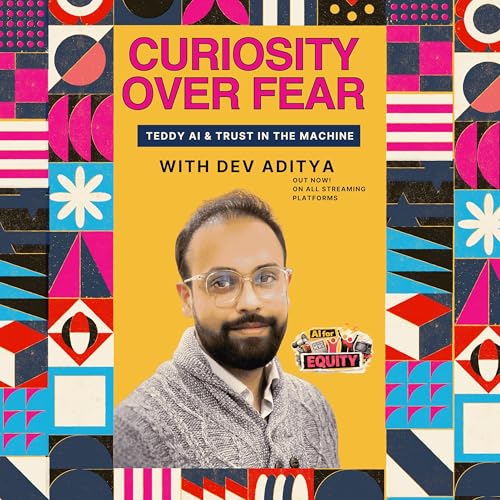
  • Curiosity Over Fear: Dev Aditya on Teddy AI, Children and Trust in the Machine
    May 27 2026

    Dev Aditya has built the world's first publicly available AI teacher, an AI model for children with hearing impairments, and Teddy AI, a learning tool for young kids. Through OIAI, his work has reached tens of thousands of learners across four continents.

    In this episode, we talk about what equity in AI education actually looks like, how children decide to trust a machine, and why curiosity matters more than fear when shaping how the next generation meets AI.

    Hosted by Jenny Garrett OBE and Leah Garrett.

    Show More Show Less
    35 mins
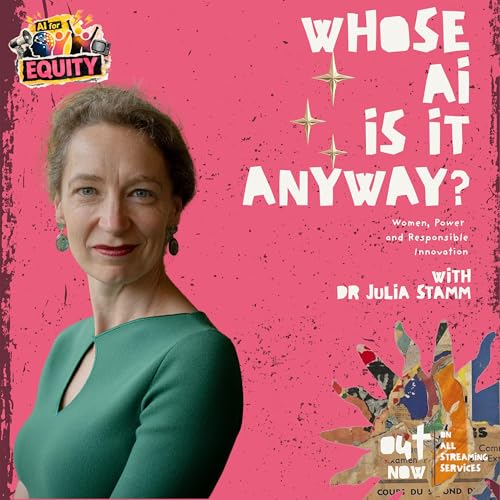
  • Whose AI is it anyway? Julia Stamm on Women, Power and Responsible Innovation
    May 20 2026

    In this episode of AI for Equity, Jenny Garrett OBE and Leah Garrett sit down with Julia Stamm, founder of C-Shapes AI and a leading voice on responsible AI innovation in Europe. Julia came to AI through social science, not engineering, and that lens shapes everything about how she works: from her years funding innovation across European institutions to her current mission of amplifying the women pioneering responsible AI.

    We talk about why AI is a human capability challenge before it's a technical one, why the same handful of names keep dominating the AI conversation, and what it actually takes to build a more inclusive ecosystem. Julia shares the thinking behind C-Shapes AI, the role of education and regulation in responsible AI use, and the practical work of equipping female leaders with the strategic fluency to engage confidently with AI in their organisations.

    If you're interested in where technology meets power, diversity, and social impact, this conversation is for you.

    In this episode:

    • Julia's path from social science to AI leadership
    • Why technology doesn't exist in a vacuum
    • The visibility problem for women in AI
    • Responsible AI as a collective responsibility
    • Building diverse AI ecosystems that deliver real outcomes
    • The Responsible AI Use Act and what it signals for Europe

    Follow AI for Equity for new episodes every week.

    #AIforEquity #WomenInAI #ResponsibleAI #DiversityInTech

    Show More Show Less
    51 mins