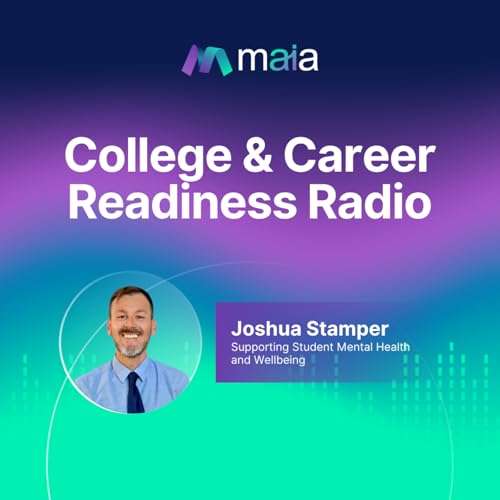
College & Career Readiness Radio cover art

College & Career Readiness Radio

College & Career Readiness Radio

By: T.J. Vari
Listen for free

College & Career Readiness Radio with T.J. Vari

A podcast about all things career and college readiness. Brought to you by MaiaLearning.

MaiaLearning Inc. 2024
Episodes
  • The Education Supply Chain Problem with Jeremy Smith
    Jul 7 2026

    Our guest for this episode of College & Career Readiness Radio is Jeremy Smith, workforce development innovator and college reform advocate.

    Jeremy says the debate about college shouldn't be whether it's good or bad, but whether it's delivering the right education to the right students at the right time and price.

    He argues that higher education is increasingly out of sync with employers, leaving many graduates with degrees but without the skills companies are hiring for.

    Jeremy says agility will define successful colleges in the AI era, and institutions must adapt their programs as quickly as the workforce changes.

    He believes liberal arts education is critically important, but it should be viewed as a lifelong pursuit rather than something condensed into four years between ages 18 and 22.

    Jeremy says the value of the humanities isn't measured by job preparation alone but by helping people become thoughtful, informed citizens.

    He argues that students should carefully weigh the return on investment of a degree and avoid taking on excessive debt for programs that don't provide a clear financial pathway.

    Jeremy says employers are the ultimate customers of workforce education because they determine whether graduates have the skills needed to succeed in today's economy.

    He encourages schools to strengthen the connection between K-12, higher education, and industry so students develop both durable skills and meaningful career opportunities.

    Jeremy explains that his popular "WTF Wednesday" LinkedIn series uses real college courses to challenge assumptions about higher education and spark conversations about affordability and educational priorities.

    His final message: education should prepare people for productive careers while also developing them into lifelong learners and engaged citizens—but those two goals don't have to be achieved through the same model.

    College & Career Readiness Radio is brought to you by MaiaLearning, your fully comprehensive college and career planning tool. Schedule a demo today.

    Show More Show Less
    47 mins
  • Possibility Thinking and Industry-Based Literacy with Dr. Sandra Adams
    Jun 23 2026

    Our guest for this episode of College & Career Readiness Radio is Dr. Sandra Adams, a nationally recognized CTE leader, author, and advocate for high-quality career and technical education who focuses on expanding opportunity, literacy, and workforce readiness for students.

    Dr. Adams begins by saying that possibility thinking is about reimagining teaching so students connect with supportive people and build real efficacy through mastery.

    She says teachers should move away from content delivery and toward helping students partner with resourceful people who expand opportunities.

    Sandra says work-based learning should be embedded all year and adapted to local needs, not treated as a one-size-fits-all model.

    She says the client pitch is her favorite example of classroom WBL, because it brings real problems from the community into the classroom.

    Sandra says feedback from partners should include descriptive and directional feedback, not just correction or evaluation.

    She says networking is one of the most important skills in the age of acceleration, so students need explicit practice with it.

    Dr. Adams tells listeners that students should sound like experts by using industry language and technical vocabulary in authentic contexts.

    She says vocabulary should never be taught in isolation; it should always be taught in context.

    Sandra says all educators are literacy teachers, and she frames literacy through TWIRLS: thinking, writing, reading, listening, and speaking.

    Her final message: exposure is the key, and no one should cap what a 17-year-old can do.

    This episode of College & Career Readiness Radio is brought to you by MaiaLearning, a fully comprehensive college and career readiness platform. If you want a demo of the features of MaiaLearning that support what was discussed in this episode, including career research and planning and a work-based learning tracking system, schedule your demo today.

    Show More Show Less
    32 mins
  • Supporting Student Mental Health and Wellbeing with Joshua Stamper
    Jun 9 2026

    Our guest for this episode of College & Career Readiness Radio is Joshua Stamper, author of The Language of Behavior.

    Josh says that student behavior should be read as communication, not just defiance, because students often signal unmet needs, stress, or trauma through what they do in class.

    He explains that many behavior issues start when students are in survival mode, which makes it hard for them to regulate emotions, listen, or hold a conversation.

    Stamper says educators should first consider the environment, since classroom setup, wall clutter, furniture placement, and other sensory factors can make students feel unsafe or overstimulated.

    He notes that the second step is exploring the breakdown, meaning adults should identify what a behavior might actually be communicating instead of assuming it is simple disruption or boredom.

    Stamper argues that responding intentionally means using consequences that match the behavior, helping the student take ownership, teaching the replacement skill, and avoiding punishments that only increase fear.

    He describes check-ins as a practical way to track student well-being over time and catch changes in baseline before problems escalate.

    Josh tells listeners that trusted adult relationships are essential, because students are more likely to disclose hard situations and accept help when they feel safe with someone at school.

    He notes that counselors and schools should use data, in-person check-ins, and follow-up conversations to respond early when a student’s baseline shifts.

    Stamper says students also need direct teaching about their brains, emotions, and self-regulation so they can build control and coping skills for school and life.

    He connects this work to post-secondary readiness, saying students need durable life skills like empathy, communication, relationship-building, and stress management to succeed in college, careers, and adulthood.

    His closing message is that schools should ask whether they truly treat behavior as communication, and if so, respond with compassion, empathy, and a focus on decoding student needs.

    "The best way to get knowledge to the brain is through the heart." ~ Joshua Stamper

    This episode of College & Career Readiness Radio is brought to you by MaiaLearning, a fully comprehensive college and career readiness platform. If you want a demo of the features of MaiaLearning that support what was discussed in this episode, including wellbeing assessments, data collection, and student flourishing results, schedule your demo today.

    Show More Show Less
    28 mins
adbl_web_anon_alc_button_suppression_t1
No reviews yet