Let's Talk Brain Health! 🧠 cover art

Let's Talk Brain Health! 🧠

Let's Talk Brain Health! 🧠

By: Virtual Brain Health Center
Listen for free

What can you do today to care for your brain? 🎙 "Let's Talk Brain Health!" is where science meets story. We bring together the world's leading experts—neuroscientists, physicians, psychologists, nutritionists—and the 'lived experience' experts navigating brain health journeys firsthand, to answer the biggest questions about memory, cognition, and dementia prevention. We dive into the brain health science, push the limits of knowledge, and deliver takeaways you can use today. For health enthusiasts, caregivers, clinicians—plus FREE accredited CEs on ALL episodes for select medical providers.Virtual Brain Health Center Hygiene & Healthy Living
Episodes
  • Sunlight Is the Unspoken Nutrient: Vision, Light & Brain Health with Dr. Marion Van Horn, PhD
    Jun 24 2026
    When was the last time you stepped outside and just looked up?Not at your phone. Not at a screen. Just up — at the sky, the light, the world around you. If it has been a while, your brain has noticed. And this week's guest is going to tell you exactly why that matters.In this episode of the Let's Talk Brain Health! Podcast, Dr. Krystal Culler sits down with Dr. Marion Van Horn — neuroscientist, science communicator, and mother of three — for a conversation that will change the way you think about your eyes, your light environment, and your brain health.Vision is not just seeing. It is how your brain regulates your mood, sets your sleep, manages your emotions, and builds its picture of the world — all in milliseconds. And natural light — something most of us walk past every day — is one of the most powerful inputs our brains receive. Dr. Marion calls it the unspoken nutrient. And after this episode, you will never think about sunlight the same way again.This episode also features a special collaboration —'Take a Brain Break'—' coloring page created by Dr. Marion Van Horn, Dr. Maria Zamfir, and Dr. Krystal Culler. Find it free in the show notes.What You'll Learn in This Episode🧠 How the brain actually learns to see — and why vision is not automatic at birth🧠 What neuroplasticity means for visual development across the lifespan🧠 Why natural sunlight is the unspoken nutrient your brain needs every day🧠 The relationship between light, circadian rhythms, sleep, and mood🧠 What screens and artificial light are doing to your brain and body🧠 How visual pathways connect directly to emotional centers — including the amygdala🧠 Why going outside when you feel overwhelmed works neurologically — not just psychologically🧠 How the two eyes work together to create three-dimensional vision🧠 Why vision loss is a modifiable risk factor for dementia — and why your annual eye exam matters🧠 Practical steps to protect your visual brain health starting todayKey Takeaways✔ Natural light is the unspoken nutrient — get outside within the first hour of waking, even for a few minutes✔ Vision actively regulates how you feel and how you interact with the world — it is so much more than seeing✔ Your eyes are part of your brain — protecting your vision is protecting your brain✔ Going outside changes your gaze, your nervous system, and your emotional state✔ Uncorrected vision loss increases dementia risk — prioritize your annual eye exam at every age✔ Small consistent habits — morning light, noticing the sunrise, watching the moon — add up over timeEarn FREE CEsThis podcast qualifies for the following credit types: AMA PRA Category 1, ANCC, AAPA, APA, ASWB, and IPCE. Join the Learn at Pinnacle app to earn FREE CE credit for listening to this episode!Support the PodcastIf you enjoyed this episode, please help us grow the conversation around better brain health:Follow or subscribe to the Let's Talk Brain Health! PodcastLeave a rating or reviewShare this episode with a friend, colleague, or fellow brain health advocateThank you for investing your time and energy into your brain health. A special thank you to Dr. Marion Van Horn, PhD for reminding us that one of the most powerful things we can do for our brains costs nothing at all. Go outside. Look up.Resources:Explore Marion’s work and resources on ⁠her website⁠Connect with Marion on Social media @marion.phd on ⁠Instagram ⁠Download Our “Let’s Take A Brain Break” coloring page on our websiteContinue to learn from The Neuron Family on Instagram or their newsletterCheck out The Neuron Family’s colouring books on its website or LinkTr.eeOrder Volume 1: The BrainOrder Volume 2: How We FeelOrder Volume 3: How We See
    Show More Show Less
    39 mins
  • Why Your Brain Needs Play: Creativity, Confidence & Connection with Rachael Renae
    Jun 10 2026
    What if one of the most powerful tools for your brain health has been sitting on the shelf since childhood — and you just forgot to pick it back up? In this episode of the Let's Talk Brain Health! Podcast, Dr. Krystal Culler, DBH, MA sits down with Rachael Renae— artist, play enthusiast, creative educator, and debut author of Prioritize Play: Express Your Creativity, Boost Your Confidence, and Foster Deeper Connection — for a conversation that will change the way you think about play, creativity, connection, and what it truly means to care for your brain.We often hear brain health advice centered on movement, sleep, nutrition, and stress management. But how often are we told to write a haiku between meetings, make a seasonal play playlist, or simply follow the fun — just for the brain-building benefit of it? The science says we should be.A former engineer with over a decade in her field, Rachael discovered that what was missing from her life wasn't a career change — it was play. This conversation is for anyone who has ever said "I'm not creative," "I don't have time for play," or quietly wondered why life feels a little gray lately.What You'll Learn in This Episode🧠 Why play is not frivolous — it is a brain-building practice backed by science🧠 What play actually is and the key ingredients that make something truly playful for adults🧠 Why every single person is creative, whether they believe it or not🧠 What the brain loses across creativity, confidence, and connection when play disappears🧠 How play supports stress reduction, emotional processing, neuroplasticity, and social bonding🧠 How to find time for play using things you are already doing every day🧠 Practical 5-minute play challenges — no equipment, no budget, no free afternoon required🧠 What the "Friend File" is and how it addresses loneliness and social isolation🧠 How to rewire your brain to seek wonder in everyday routines🧠 The power of the seasonal "playlist" — a to-do list made up entirely of play activitiesKey Takeaways✔ Play belongs on your to-do list right next to the groceries and the bills✔ Creativity is not a talent reserved for artists — it is a built-in human need✔ Small, consistent, intentional moments of play rewire the brain toward curiosity and connection✔ Non-zero play days are enough — one small playful moment today is a powerful place to startEarn FREE CEsThis podcast qualifies for the following credit types: AMA PRA Category 1, ANCC, AAPA, APA, ASWB, and IPCE. Join the Learn at Pinnacle app to earn FREE CE credit for listening to this episode!ResourcesExplore Rachael’s work and resources on her websiteCheck out her new book, “Prioritize Play: Express Your Creativity, Boost Your Confidence, and Foster Deeper Connection”Learn more about Rachael’s creative community, the Juice BoxListen to the “Chaotic Creatives” podcast on Apple & SpotifyConnect with Rachael on Social media @RachaelRenae on Instagram Learn more about our “A Kids Book About Brain Health” on our website and download our free coloring pages– fun for all ages! Support the PodcastIf you enjoyed this episode, please help us grow the conversation around better brain health:Follow or subscribe to the Let's Talk Brain Health! PodcastLeave a rating or reviewShare this episode with a friend, colleague, caregiver, or fellow brain health advocateExplore Previous Episodes Related to the Topic of Play:Episode 7: The Creative Path to Optimal Brain Health with Ty HaglerEpisode 27: The Fun Habit: Exploring the Science of Fun for Brain Health with Dr. Mike Rucker, Ph.D.Episode 74: The Arts as the Fifth Pillar of Health: Brain Health, Longevity, and Dementia Prevention with Dr. Daisy Fancourt, Ph.D.Thank you for investing your time and energy into your brain health. A special thank you to Rachael Renae for reminding us all that a more joyful, connected, and fulfilling life is only one playful moment away.
    Show More Show Less
    42 mins
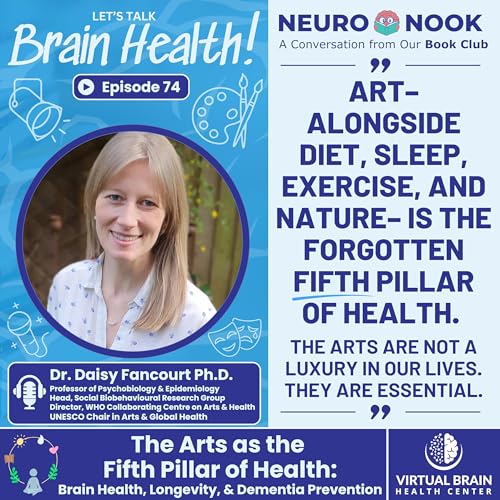
  • The Arts as the Fifth Pillar of Health: Brain Health, Longevity, and Dementia Prevention with Dr. Daisy Fancourt, Ph.D.
    May 13 2026
    **This special podcast episode was recorded live as part of the Virtual Brain Health Center’s Neuro Nook book club, where readers explored The Art Cure together before welcoming Dr. Fancourt for this live discussion.What if one of the most powerful tools for supporting brain health has been hiding in plain sight?In this episode of the Let’s Talk Brain Health! Podcast, Dr. Krystal Culler and Heather Elwell, co-host of the Neuro Nook brain health book club, sit down with internationally recognized researcher Dr. Daisy Fancourt, author of The Art Cure: The Science of How the Arts Save Lives, for a fascinating conversation about why the arts may be the forgotten fifth pillar of health.We often hear health advice centered on movement, sleep, nutrition, stress management, and routine medical care. But how often are we told to read a book, visit a museum, sing, dance, paint, or attend a live performance for our health?The science says we should be.Dr. Fancourt shares decades of research showing how arts engagement supports mental health, physical health, social wellbeing, and cognitive health. Whether you identify as creative or not, this episode may change how you think about what belongs in your personal brain health routine.What You’ll Learn in This Episode🧠 Why the arts are considered the forgotten fifth pillar of health🧠 What counts as “arts engagement” & why it is broader than many people realize🧠 The difference between active participation and receptive engagement, and why both matter🧠 What happens in the brain when you listen to music, read, dance, create, or experience the arts🧠 How arts engagement influences dopamine, stress hormones, inflammation, and emotional well-being🧠 The connection between the arts, neuroplasticity, cognitive reserve, and dementia risk reduction🧠 New research linking arts engagement to biological aging and longevity🧠 Why arts participation supports healthy aging across the lifespan🧠 Practical ways to build creative engagement into your everyday routine🧠 Why equitable access to the arts is also a public health issueWho Should ListenThis episode is for: Adults interested in brain health & healthy aging Individuals concerned about memory or dementia preventionHealthcare and public health professionalsEducators & community leadersArtists, creatives, and arts advocatesAnyone who has ever said, “I’m not artistic,” or “I’m not creative”Key Takeaways✔ The arts are not a luxury. They are a meaningful health behavior✔ Arts participation may help strengthen cognitive reserve and protect long-term brain health✔ Both creating art and experiencing art offer measurable health benefits✔ Small, consistent creative habits can make a difference over time✔ Healthy aging is not only about what you remove from life. It is also about what you addEarn FREE CEsThe podcast qualifies for the following credit types: AMA PRA Category 1, ANCC, AAPA, APA, ASWB, and IPCE.Join the Learn at Pinnacle app ⁠⁠to earn FREE CE Credit for listening to this episode!Support the PodcastIf you enjoyed this episode, please help us grow the conversation around better brain health:Follow or subscribe to the Let’s Talk Brain Health! PodcastLeave a rating or reviewShare this episode with a friend, colleague, book club, or fellow brain health advocateThank you for investing your time and energy into your brain health.A special thank you to Dr. Daisy Fancourt for sharing her expertise and advocacy, and to our Neuro Nook community for making this live book club conversation possible.Resources:Explore the additional resources from “The Art Cure” book and projectConnect with The Social Biobehavioural Research Group, Dr. Daisy Fancourt’s Research Lab Subscribe to Dr. Fancourt’s NewsletterFollow the Social Biobehavioural Research Group on LinkedIn, X, & Blue SkyLearn more about the Neuro Nook (book club) from the Virtual Brain Health CenterReview the Neuro Nook (book club) summary of The Art Cure
    Show More Show Less
    34 mins
adbl_web_anon_alc_button_suppression_t1
No reviews yet