• The First Postmodernist: How Michel Siffre Lost God in the Darkness
    Jun 13 2026

    This episode explores Sean Dempsey’s 2025 novel The Lost Tapes of Doctor Michel Siffre not merely as a historical thriller, but as a profound cultural allegory for the spiritual condition of the modern West. While Michel Siffre was a real French geologist who famously isolated himself deep underground in the 1960s and 1970s to study human perception of time, Dempsey transforms those experiments into something far more symbolic. The hosts argue that Siffre’s descent into the lightless depths of Midnight Cave mirrors civilization’s simultaneous descent into the intellectual darkness of postmodernism. As traditional sources of meaning—religion, objective truth, shared narratives, and cultural certainty—began to erode during the late twentieth century, Siffre found himself physically experiencing the very condition that philosophers were increasingly describing: a world untethered from fixed reference points. His loss of temporal orientation becomes a powerful metaphor for a culture losing its metaphysical bearings.


    Throughout the discussion, the hosts examine key passages from Siffre’s recordings and compare them to the emerging ideas of thinkers such as Michel Foucault, Jacques Derrida, and Jean-François Lyotard. The cave becomes a living embodiment of postmodern thought: a place where certainty dissolves, narratives fracture, and reality itself becomes suspect. What begins as a scientific inquiry slowly transforms into a confrontation with nihilism, loneliness, and the terrifying possibility that meaning is neither discovered nor guaranteed. The hosts pay particular attention to moments where Siffre questions the nature of truth, memory, and identity, arguing that his psychological unraveling parallels the broader cultural journey from modern confidence to postmodern skepticism.


    The episode concludes by tracing the evolution of postmodernism from Siffre’s era to the present day. What began as an intellectual critique of certainty eventually escaped the academy and reshaped politics, culture, religion, and personal identity. Yet the hosts argue that the story does not end in darkness. Just as Siffre ultimately emerged from the cave, contemporary culture appears to be searching for a path beyond pure deconstruction. The discussion explores whether newer movements such as Metamodernism represent an attempt to climb back toward meaning without abandoning the lessons learned in the darkness. In that sense, The Lost Tapes of Doctor Michel Siffre becomes more than a novel about a man trapped underground—it becomes a meditation on an entire civilization wandering through its own cave, searching for a way back to the light.

    Show More Show Less
    30 mins
  • Campaign Promises vs. Political Reality: When the Slogan Met the Swamp
    Jun 12 2026

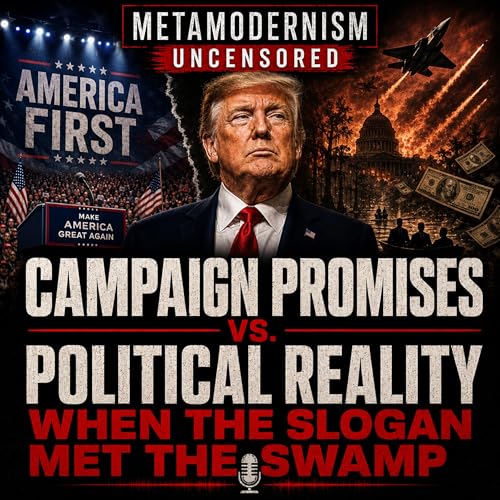
    This episode of Metamodernism Uncensored asks the brutal question: when did America First become America Last? The hosts first dissect Donald Trump’s most sacred campaign promise (i.e. “no new wars!”) by walking through his own words from CPAC, the RNC, State College, and election night, where he repeatedly vowed to avoid foolish foreign wars and stop global conflict. They then contrast those promises with his decision to launch an unprovoked, undeclared, unconstitutional war on Iran on behalf of Israel, arguing that this marked the moral collapse of Trump’s America First brand.

    From there, the episode follows the money and the broken promises. The hosts examine the influence of pro-Israel megadonors, including Miriam Adelson, and Trump’s retreat from the antiwar figures who helped build his movement — Tucker Carlson, Megyn Kelly, Candace Owens, Alex Jones, and Thomas Massie — while embracing neoconservative voices like Lindsey Graham, Ted Cruz, Ben Shapiro, and Mark Levin. They also explore Trump’s reversal on the Epstein files, his softened stance on mass deportations after promising the largest deportation operation in American history, and the political destruction of Massie after he tried to hold Trump accountable to his own stated principles.

    The episode concludes with a grim diagnosis: Trump did not merely break a few campaign promises. He exposed the fragility of the entire America First project when confronted by money, ego, donor pressure, foreign influence, and the temptations of power. What began as a movement against endless wars, elite corruption, and globalist capture ended as a familiar Washington tragedy... the swamp survived, the neocons returned, Israel got its war, and “America First” quietly became “Israel First.”

    Show More Show Less
    34 mins
  • The Idiot and the Coach: Postmodernism Killed Innocence; Ted Lasso Brought It Back
    Jun 11 2026

    What if the problem with our age is not that we are too naïve, but that we are no longer innocent enough to be saved?

    This episode puts Dostoevsky’s The Idiot and the AppleTV comedy Ted Lasso into philosophical combat, asking why one holy fool is destroyed by the world while the other somehow redeems it. Prince Myshkin enters a diseased Russian society armed with radical goodness, only to be humiliated, manipulated, and spiritually crushed. Ted Lasso enters a world just as cynical, sarcastic, wounded, and self-protective, but instead of being devoured by it, he slowly infects it with decency. The contrast becomes a diagnosis of culture itself: modernism feared goodness could not survive corruption, postmodernism laughed at goodness as childish delusion, and metamodernism dares to ask whether sincerity might be revolutionary again.

    After fifty years of irony, deconstruction, therapy-speak, and fashionable despair, Ted Lasso feels almost scandalous because he refuses the central commandment of our age: thou shalt not be earnest. He is not stupid. He is not untouched by pain. His optimism survives divorce, panic attacks, loneliness, and failure, which makes it stronger than cynicism rather than weaker. This episode argues that the innocent fool may be returning as a cultural necessity, not because the world is pure, but because it is so obviously poisoned. Maybe the next rebellion will not be rage, irony, or ideological warfare. Maybe it will be the terrifying, unfashionable act of believing in people again.

    Show More Show Less
    32 mins
  • Trump’s Iran War: When America First Became Israel First
    Jun 10 2026

    This episode of Metamodernism Uncensored takes aim at what the hosts see as the widening gap between Donald Trump’s America First rhetoric and the reality of U.S. foreign policy in the Middle East. They argue that Trump’s recent statements about Iran and Israel sound less like independent presidential judgment and more like a repackaging of Israeli hardline talking points: regime change in Iran, alarm over nuclear weapons, invocations of October 7th, and vague promises to restrain Israel while Israeli settlements continue to make a Palestinian state functionally impossible. To the hosts, the issue is not merely Trump’s inconsistency, but the deeper humiliation of a superpower that funds Israel’s military while refusing to use that aid as leverage.

    The episode broadens into a harsh critique of America’s bipartisan loyalty to Israel, contrasting today’s unconditional support with earlier presidents like Eisenhower, Reagan, and George H.W. Bush, who were at least willing to pressure Israel when U.S. interests demanded it. The hosts frame this loyalty as the product of foreign lobbying, donor influence, and political fear, singling out figures like Miriam Adelson and arguing that massive campaign money has helped turn American foreign policy into something openly transactional. They also highlight Tucker Carlson’s claim that Netanyahu privately boasts about his influence over Washington, using it as evidence of what they see as a grotesque inversion of power.

    The hosts then turn to public opinion, arguing that the old consensus is cracking—especially among younger conservatives who no longer get their worldview from Fox News or establishment Republican media. Trump’s approval, they say, is being damaged by the Iran war, and younger Republicans are far less supportive of military escalation than older voters. The episode closes by attacking the American media’s reflexive defense of Israeli policy, its treatment of Palestinian suffering, and its tendency to smear dissent as antisemitism. Against that backdrop, the hosts praise Ro Khanna as one of the few politicians willing to say plainly that the American president—not Israel—should be directing U.S. foreign policy.

    Show More Show Less
    22 mins
  • Sean & Brendan Dempsey Discuss The Fiction of Value
    Jun 9 2026

    In this special rebroadcast episode of Metamodernism Uncensored, Sean Dempsey revisits a 2023 conversation from Brendan Graham Dempsey’s Metamodern Meaning Podcast, in which a wide-ranging brotherly dialogue unfolds on postmodernism, money, culture, morality, and the strange modern fiction we call “value.”

    Brendan and Sean explore what happens when value becomes detached from reality. The conversation begins with moral ambiguity in modern film (from Star Wars to Batman), and expands into a deeper critique of a culture that increasingly treats truth, worth, and meaning as subjective constructions. Sean argues that postmodern relativism has escaped the realm of art and infected economics itself, showing up in fiat currency, NFTs, speculative bubbles, Modern Monetary Theory, and the belief that money can be created without consequence. Brendan pushes the discussion into more philosophical terrain, asking whether socially constructed value is always fraudulent — or whether collective belief, hype, and imagination can sometimes create real value after the fact.

    The result is a provocative and intellectually restless exchange touching on Sam Bankman-Fried, modern art, the duct-taped banana, Social Security, the Federal Reserve, GDP, Austrian economics, the broken window fallacy, AI, education, the wealth gap, and the moral legitimacy of the state. At the center of it all is one deceptively simple question: who decides what anything is worth?

    Rather than a tidy ideological debate, this episode becomes a genuine dialectic between two brothers: Brendan probing the philosophical gray areas, Sean pressing the case for moral and economic reality. The Fiction of Value asks whether America’s cultural and financial order is built on productive imagination — or on a collapsing tower of abstractions no one is willing to call empty.

    Show More Show Less
    1 hr and 25 mins
  • The Free State Project: How New Hampshire Escaped the Progressive Plantation
    Jun 8 2026

    This episode of Metamodernism Uncensored features a deep-dive conversation between Sean Dempsey and Claire Brooks on the strategy, mechanics, and concrete victories of the Free State Project (FSP) in New Hampshire. Moving past the frustration of national politics—which the hosts liken to a "rooster crowing the sun into existence"—they argue that the physical concentration of liberty-minded activists is the only mathematically viable way to counter the creeping expansion of federal and state-level socialism. By centering their efforts on New Hampshire's unique 400-member volunteer citizen legislature, FSP migrants and local liberty coalitions have successfully translated political temperament into neighborhood and state law, establishing a blueprint for decentralized resistance.

    The hosts back up this philosophical framework with an exhaustive review of the FSP's legislative ledger, detailing how targeted activism has dismantled state monopolies piece by piece. They discuss major civil liberties victories, including Constitutional Carry (SB12), Civil Asset Forfeiture reform (SB522), and Jury Nullification (HB146), alongside sweeping economic reforms like the total repeal of the Interest and Dividends Tax (HB2) and the creation of Education Freedom Accounts (SB130). Finally, the episode explores the advanced frontiers of state-level sovereignty, highlighting the groundbreaking gold and crypto strategic reserve law (HB302), the repeal of the annual passenger vehicle inspection (HB649), and localized deregulation battles over food freedom and accessory dwelling units (ADUs).

    Show More Show Less
    13 mins
  • Are Tariffs Patriotic or a Self-Inflicted Wound?
    Jun 7 2026

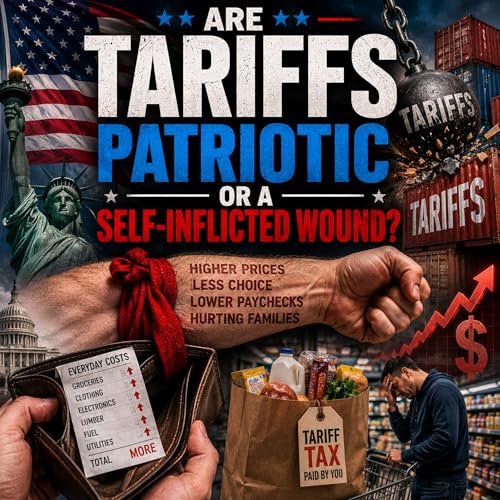
    Politicians call tariffs "economic patriotism." This episode calls them what they really are: a tax on your family disguised as punishment for someone else.

    Using history, economics, and a few uncomfortable examples, we examine the claim that tariffs protect American workers. The hosts argue instead that trade wars are self-inflicted wounds. They functionally perform to raise prices on everything from groceries to electronics while quietly transferring wealth from consumers to politically connected industries. From Adam Smith to Milton Friedman, economists across centuries have reached the same conclusion: tariffs don't make a country richer. They just make its citizens pay more.

    If tariffs are so beneficial, why do consumers always end up footing the bill? And why do politicians keep selling the same idea generation after generation? This episode challenges one of the most popular economic myths in American politics and asks whether "protecting" the economy is really just another word for making everything more expensive.

    Show More Show Less
    51 mins
  • Metamodernism in The Age of Shifting Sand: Can a Broken World Build the Next Stable One?
    Jun 6 2026

    Sean Dempsey's article "Metamodernism in The Age of Shifting Sand: Can a Broken World Build the Next Stable One?" serves as the foundation for a provocative discussion about whether today's social, economic, and cultural instability is actually laying the groundwork for a more stable future. The hosts argue that modern society has become untethered from traditional notions of truth, morality, value, and even biological reality. They explore how postmodern thinking has encouraged a world where meme-coins can command billions of dollars, debt can be treated as inconsequential, and companies can build entire business models around speculative promises rather than productive output. Rather than approaching these developments through a libertarian lens of individual freedom, the episode frames them as symptoms of a deeper philosophical crisis in which reality itself has become negotiable. The discussion then introduces metamodernism as a potential successor to postmodernism, arguing that society cannot survive indefinitely on irony, deconstruction, and moral relativism, and must eventually rediscover concepts such as truth, meaning, responsibility, and objective value.

    The episode's most fascinating and controversial thesis centers on a profound historical irony: the same bubble economy and speculative excesses that appear to be destabilizing civilization may also be financing its eventual renewal. Drawing on thinkers such as Heraclitus, Hegel, Nietzsche, Camus, and metamodern philosopher Brendan Graham Dempsey, the hosts explore whether chaos can generate a higher order or whether it simply ends in collapse and nihilism. They compare today's AI boom, crypto speculation, and easy-money environment to previous bubbles that left behind transformative infrastructure, such as railroads and the internet. While acknowledging the possibility that the current system could end in ruin, the conversation ultimately wrestles with a deeper question: can a morally confused civilization accidentally build the tools for its own redemption? The episode concludes by suggesting that history is often built by imperfect people pursuing imperfect motives, leaving listeners with the unsettling possibility that today's madness may one day be remembered not as the end of a civilization, but as the chaotic birth of its successor.

    Full article being discussed: https://the-opposition.com/2026/06/metamodernism-in-the-age-of-shifting-sand-can-a-broken-world-build-the-next-stable-one/

    Show More Show Less
    41 mins