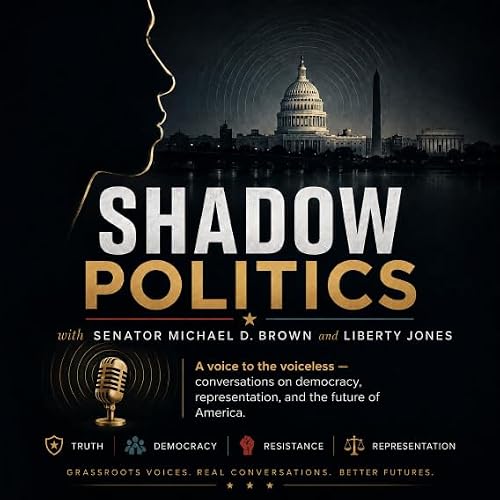
Shadow Politics with US Senator Michael D Brown cover art

Shadow Politics with US Senator Michael D Brown

Shadow Politics with US Senator Michael D Brown

By: Senator Michael D. Brown
Listen for free

Shadow Politics is a grass roots talk show giving a voice to the voiceless. For more than 200 years the people of the Nation's Capital have ironically been excluded from the national political conversation. With no voting member of either house of Congress, Washingtonians have lacked the representation they need to be equal and to have their voices heard. Shadow Politics will provide a platform for them, as well as the millions of others nationwide who feel politically disenfranchised and disconnected, to be included in a national dialog. We need to start a new conversation in America, one that is more inclusive and diverse and one that will lead our great nation forward to meet the challenges of the 21st century. At Shadow Politics, we hope to get this conversation started by bringing Americans together to talk about issues important to them. We look forward to having you be part of the discussion so call in and join the conversation. America is calling and we're listening… Shadow Politics is about America hearing what you have to say. It's your chance to talk to an elected official who has spent more than 30 years in Washington politics. We believe that if we start a dialog and others add their voices we will create a chorus. Even if those other politicians in Washington don't hear you — Senator Brown will. He's on a mission to listen to what America has to say and use it to start a productive dialog to make our democracy stronger and more inclusive. If we are all part of the solution we can solve any problem.Copyright 2026 Senator Michael Brown Political Science Politics & Government
Episodes
  • Shadow Politics, June 29, 2026
    Jun 30 2026
    Shadow Politics with Senator Michael D. Brown and Co-host Liberty Jones Across the Divide Trump, Immigration, War, and the Fight to Keep Talking A Conversation Across Political Lines In this episode of Shadow Politics, host Michael D. Brown and co-host Liberty Jones welcome Steve, a friend of Senator Brown’s and a three-time Donald Trump voter, for a direct but civil conversation about politics, values, immigration, foreign policy, and America’s divisions. Brown opens by stressing that people on the other side of political disagreement are not enemies, but friends, family, neighbors, and coworkers whose views should be heard. The episode’s central purpose is dialogue: not telling listeners how to feel or vote but modeling a difficult conversation across political lines. Why Steve Supports Trump Steve explains that his support for Donald Trump is rooted primarily in policy and action. He says he wanted an outsider who could get things done, rather than another traditional politician who promised everything and accomplished little. He also says he admired Trump’s business image for many years. When Liberty asks what Trump may be remembered for historically, Steve points to immigration, arguing that Trump closed the border and took action on an issue he believes other politicians ignored. At the same time, Steve acknowledges that people who have lived in the United States for many years, worked, paid taxes, and built lives here should have some fair path toward legal status. Immigration, Benefits, and Competing Narratives Much of the early conversation centers on immigration. Steve argues that illegal immigration affects public safety, jobs, benefits, and fairness to taxpayers. Brown challenges several of those claims, especially the idea that undocumented immigrants receive broad government benefits, saying that many such claims are myths or exaggerated political narratives. Liberty asks Steve when he first felt personally affected by illegal immigration, and Steve describes experiences from his youth in California. The exchange reveals the emotional and factual gap between how immigration is experienced by some voters and how Brown and Liberty interpret the policy realities. Foreign Policy, Iran, Venezuela, and Military Power The discussion then moves into Trump’s foreign policy and the question of whether he broke his promise not to involve the United States in foreign wars. Brown criticizes military actions involving Iran and Venezuela, arguing that regime-change thinking and resource interests are driving decisions. Steve defends Trump’s willingness to act decisively against dictators and threats, especially when allies such as Israel are involved. Liberty raises concerns about taxpayer money, military depletion, and U.S. intervention in the domestic politics of other countries, while Steve maintains confidence in America’s military strength and Trump’s instincts. Trump’s Conduct, Profit, and Public Image Brown presses Steve on Trump’s personal conduct, business history, side ventures, taxes, treatment of women, racial rhetoric, and public spectacle. Steve largely defends Trump or says those issues do not bother him as much as Trump’s policies and results. The hosts debate whether the presidency should carry a higher standard of dignity, especially regarding events on White House grounds, Trump’s public language, and the image America projects to the world. Liberty adds that Trump’s celebrity instincts may be part of both his appeal and the reason American politics has become so polarized. Democrats, Democratic Socialism, and the Future of Elections Steve asks Brown to explain the difference between Democrats and democratic socialists. Brown describes democratic socialism as a belief that government should provide more basic services and stability for citizens, distinguishing it from communism. He names Bernie Sanders as a classic example and says he personally identifies with democratic socialism, especially in a future shaped by AI and economic disruption. Brown predicts that Democrats are likely to retake the House and may have a slim chance at the Senate, though he also jokes that Democrats have a talent for losing winnable elections. Finding Common Ground in a Polarized Country The conversation closes with Liberty emphasizing that most Americans want the same broad things: safety, freedom, fairness, and a better country. She asks whether constant blame-shifting helps the nation move forward, and Steve agrees that both parties need to stop blaming the past and work together. The final exchange touches on Israel, Palestine, internal party conflict, protest politics, and political violence. Despite sharp disagreement, Steve thanks Brown and Liberty for the conversation and says he hopes Americans can better understand one another. Brown ends by suggesting that more conversations like this may help, then closes the episode with humor and music.
    Show More Show Less
    57 mins
  • Shadow Politics, June 21, 2026
    Jun 22 2026
    Shadow Politics with Senator Michael D. Brown and Co-host Liberty Jones Unstoppable in Iowa: India May on Rural Power, Health Care, and Speaking Truth to Power Guest, India May, Political Candidate, Speaker, Advocate A Grassroots Conversation About Local Courage In this episode of Shadow Politics, hosts Michael D. Brown and Liberty Jones welcome India May, Democratic candidate for Iowa House District 58, covering Floyd, Chickasaw, and Bremer counties. Michael introduces her as a nurse, librarian, medical examiner investigator, mother, and community advocate who gained attention after publicly confronting Senator Joni Ernst about Medicare and Medicaid cuts. The episode focuses on local power, rural politics, health care, LGBTQ rights, campaign finance, voter access, and what it means for an ordinary citizen to step into public leadership. Discovering the Power of One Civilian Voice India says one of the biggest lessons she has learned over the past year is how much power civilians truly have. She points to her public criticism of Senator Joni Ernst, who later announced retirement, and her scrutiny of her opponent’s unpaid property taxes, after which he paid them. India’s point is that people do not have to wait until they hold office to make a difference. By speaking plainly, documenting facts, and refusing to be silent, ordinary citizens can pressure powerful figures and create real consequences. From Independent Voter to Democratic Candidate Liberty asks India about the difference between her expectations and the realities of running for office. India explains that she spent much of her voting life as an independent and is now running as a Democrat in red, rural Iowa. She says she has been pleasantly surprised by the number of people willing to step up, volunteer, knock doors, join parades, and publicly support a campaign that calls for change. She describes live music, community energy, and people applauding the campaign at local events as signs that many rural Iowans know something is wrong and want a different direction. A Campaign Rooted in Fair Voting When Liberty asks what policies are most important to India, she names voting reform as her top priority. India supports efforts discussed by Iowa gubernatorial candidate Rob Sand to make voting more fair and less dependent on party structures. She criticizes Iowa’s ban on ranked-choice voting and says she is interested in open primaries, star voting, approval voting, and ballot measures. Her goal is to make Iowa’s political system more responsive to voters rather than party machinery. Medicaid, Mental Health, and a Broken Health System Michael asks about India’s well-known confrontation with Senator Ernst over Medicaid cuts and how those cuts affect Iowans. India says Iowa has already been ahead of the curve in damaged health care because Medicaid was privatized in 2016. She describes delayed care, denied care, unpaid reimbursements to hospitals, work requirements, and hospitals struggling to stay open. She also says Iowa ranks at the bottom for inpatient mental health care availability and faces severe health care deserts, rising cancer concerns, and limited oncology access across many counties. The “Big Beautiful Bill” and Political Timing India argues that federal cuts tied to the so-called “big beautiful bill” will be devastating and says the timing of implementation appears politically calculated. According to her, the cuts are delayed until November, creating an opening for Republicans to blame Democrats if the party balance changes after the election. Michael responds that this shows she has learned one of the central lessons of politics: policy and timing are often structured to shape public blame. Christianity, MAGA, and Moral Accountability The conversation turns to religion and politics when Michael, speaking as a Christian and father of an openly gay daughter, asks how Christians reconcile cruelty toward LGBTQ people, immigrants, and vulnerable groups. India, who says she was raised Methodist, contrasts the Methodist slogan “open hearts, open minds, open doors” with what she describes as MAGA cruelty. She says even the Old Testament emphasizes hospitality to strangers and kindness to those in need, and she argues that current right-wing politics often represents the opposite of what Christ or Christianity teaches. LGBTQ Rights, Book Bans, and Iowa’s Culture War India discusses the legislative push in Iowa against LGBTQ protections, trans and nonbinary people, and public libraries. She says Republicans have enacted or pursued punishing policies against LGBTQ Iowans and banned local governments from passing protective ordinances. As a former librarian, she criticizes book bans and groups such as Moms for Liberty, saying the fear that books about gay families will “turn children gay” is baseless. She connects the fight over libraries and education to broader attempts to control speech, identity, and public ...
    Show More Show Less
    54 mins
  • Shadow Politics, June 14, 2026
    Jun 15 2026
    Shadow Politics with Senator Michael D. Brown and Co-host Liberty Jones Across the Divide: Trump, Iran, Immigration, and the Search for Common Ground A Conversation Meant to Make America Think Again In this episode of Shadow Politics, host Former Senator Michael D. Brown opens the program with the show’s mission: to make America think again by listening to all sides before forming opinions. He introduces guest William Shelton, an arborist, small business owner in the DMV area, native Washingtonian raised in Fairfax, Virginia, political science graduate of Old Dominion University, libertarian, Christian, father, gun owner, and self-described patriot. The episode centers on why Shelton voted for Donald Trump in 2024 and how his views reflect a broader segment of American political opinion. Why William Shelton Voted for Donald Trump Michael begins by asking Shelton what leadership characteristics matter most to him and how Trump meets them. Shelton says voters often do not get to choose ideal candidates; instead, candidates are packaged and presented, leaving people to choose between the available options. He says he did not find Trump’s first presidency offensive enough to prevent him from voting for Trump again in 2024. Shelton points to Trump’s presence, his ability to speak to his base, his appeal to a certain understanding of America, and his support for lower taxes and reduced regulation as reasons Trump appealed to him as a small business owner. Iran, War, and the Question of Intervention Michael then asks about the war with Iran, arguing that Iran did not have nuclear weapons, that the United States spent heavily, and that the Strait of Hormuz was already open before the conflict began. Shelton responds by connecting the issue to broader Republican and libertarian debates about war, referencing Ron Paul and the Tea Party’s antiwar instincts. He says that if the public claims about Iran’s uranium enrichment, ballistic missile capability, and regional influence through groups such as Hamas and Hezbollah were accurate, then military action could be justified if it reduced a future threat with limited loss of life. Michael challenges that view, comparing the situation to the Bay of Pigs and arguing that the intervention may have backfired. Liberty Jones Joins the Debate Co-host Liberty Jones joins after technical issues and presses Shelton on the logic of intervention. She asks how this action would achieve its stated goals, how weapons could be kept from extremists if civilians were armed, and why critics should be dismissed as politically motivated rather than answered on the merits. Shelton answers by returning to the example of appeasement and by arguing that Iran’s leadership cannot be trusted. Liberty pushes back by questioning whether immigration, instability, and religious conflict are being oversimplified, especially when broader social, economic, colonial, and policy histories are involved. Religion, Immigration, and Western Identity The conversation broadens into religion, immigration, and national identity. Shelton argues that Muslim-majority nations such as Saudi Arabia, the United Arab Emirates, Kuwait, and Dubai should take in more Muslim refugees, asking why many migrants instead go to Western countries. Michael counters that religious nationalism is dangerous whether it comes from Islamic governments or Christian fundamentalists in the United States. Liberty adds that immigration problems cannot be reduced only to religion and must also be understood through policy, education, crime enforcement, opportunity, and historical power dynamics. Trump, Race, and Immigration Claims Michael raises questions about Donald Trump and race, saying Trump has a documented history involving racial discrimination in housing. Shelton pushes back by pointing to Trump’s support among some Black, Latino, and immigrant voters. Michael responds that most Black voters did not support Trump and that some immigrant families may oppose later immigration after becoming established themselves. Liberty asks directly whether Shelton accepts inflammatory claims made about Latino immigrants. Shelton avoids endorsing the broad claim and instead says desperate individuals may act in desperate ways, while Michael and Liberty press the point that political rhetoric can turn entire groups into targets. Crime, Protest, and Conflicting Narratives The discussion then turns to crime, protests, ICE, and public safety. Shelton argues that many people support Trump because they see Democrats as projecting chaos through protests, immigration fights, and constant social conflict. Michael responds that some violence attributed to protesters is misrepresented and argues that ICE and federal enforcement can also create violence. He cites crime statistics to argue that Republican-led or gun-friendly states often have higher violent-crime rates than cities or states frequently criticized by conservatives. Shelton counters ...
    Show More Show Less
    1 hr and 4 mins
adbl_web_anon_alc_button_suppression_t1
No reviews yet