Episodes

  • The Gumball Machine Is Broken: Jon Miller on What Comes After the MQL
    Jun 3 2026
    About this episode Most B2B marketing still runs on a single number: the marketing qualified lead. Jon Miller is one of the few people who can tell you where that number came from, because he helped build the system that produced it — first at Marketo, where he helped create the marketing automation category, then at Engagio, then at Demandbase. What makes this conversation different is that Jon went back and diagnosed his own creation. He’s not quietly onto the next thing. He’s saying, out loud, what the MQL got wrong about how people actually buy — and he’s careful to credit what it got right before he takes it apart. The short version: roughly 95% of buyers have built their shortlist before they ever talk to a seller. The MQL was designed to catch the last 5% who raise their hand. So the real question isn’t how to optimize lead capture. It’s what you do with everyone who isn’t ready yet — the 95% the old model was built to ignore. We get into why buying behaves more like weather than a vending machine, the three-tier model Jon uses instead of MQLs, why he thinks legacy automation tools can’t keep up, and how the best CMOs are quietly rewiring what they report to the board. If you’ve ever felt like you were pedaling into a headwind running the playbook that used to work, this one’s for you. About Jon Miller Jon Miller founded Marketo in 2006 and helped define the marketing automation category. He went on to found Engagio, which was acquired by Demandbase in 2020, served as CMO at Demandbase, and is now building Phave, an AI-native marketing automation platform. Chapters 00:00 Introduction to Jon Miller and his journey 01:24 Diagnosing the MQL model 03:27 The gumball machine / nonlinear buying idea 07:23 What the MQL got right 10:14 The three-tiered model of engagement 14:22 The role of CMOs in modern marketing 18:17 AI’s impact on marketing automation 19:55 The Spotify playlist analogy 22:53 The Peppers and Rogers/one-to-one thread 24:43 Common mistakes moving off the MQL 25:25 The three CMO dashboards 27:25 Advice for CMOs making the shift A few things worth taking away The MQL started as a good idea — a contract between marketing and sales — and got gamed over time as teams chased volume.Buying isn’t linear. With six to sixteen people on a buying committee researching in places you can’t even track, “run a campaign, get a lead” no longer describes reality.Hand raisers are the gold standard, but waiting for them means you only ever talk to the 5% who already built their shortlist without you.Jon’s three tiers — hand raisers, MQX, and MEX — give you a way to work the 95% instead of ignoring them.When you move off MQL volume as your headline metric, expect the numbers to drop before quality and conversion rise. Set that expectation early, or you’ll hit a buzzsaw.The strongest CMOs report pipeline across all sources to the board and stop fighting over who sourced what. A few lines that stuck with me “Put your quarter in, get your gumball out. Put your campaign in, get your MQL out. I just don’t think that’s the way buying works.” — Jon Miller “If you only wait for somebody to raise their hand, you’re talking to the 5% in market. And they’ve already built their shortlist without you.” — Jon Miller “You can’t get there with a rules-based system. You just end up with spaghetti.” — Jon Miller Resources mentioned The B2B CMO Project — research on the strategic CMO and the three-dashboard modelMike Bosworth, Solution SellingDon Peppers and Martha Rogers, The One to One FutureKathleen Schaub, Marketing in the Great Big Messy Real World Transcript Brian Carroll (00:05) Welcome to The B2B Roundtable, where we go inside the ideas, people, and decisions shaping modern revenue teams and how they actually work. I’m Brian Carroll, and today my guest is Jon Miller. I first met Jon way back in 2006, when he founded Marketo and helped build the marketing automation category as we know it today. In 2015 he founded Engagio, which was acquired by Demandbase in 2020. Now he’s building Phave, an AI-native marketing automation platform. Here’s what makes this conversation different from other podcasts you’ve listened to: Jon didn’t just build the next thing and quietly move on, the way a lot of founders do. He’s gone back and started diagnosing the problems with something he previously created. He’s talking about what’s wrong, and why it’s failing buyers today. And here’s why it matters right now. Before they ever talk to a seller, 95% of buyers have already designed their shortlist. The MQL is built to capture the last 5% who self-identify. What about the 95% who haven’t yet? So, Jon — when did you first start thinking the MQL model was broken, not just underperforming? How did you get there? Jon Miller (01:24) It started, more than anything else, during my time at Demandbase. After we merged Engagio and Demandbase together ...
    Show More Show Less
    29 mins
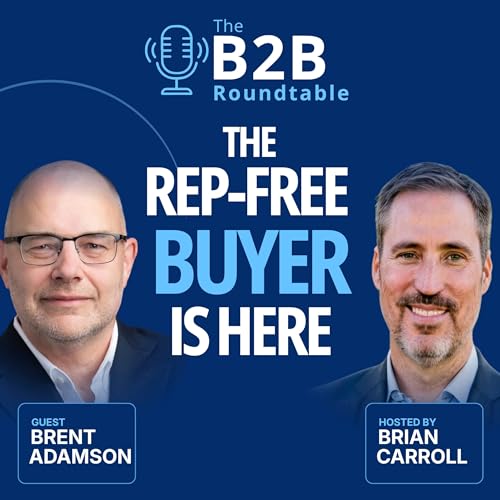
  • Why 75% of Buyers Don’t Want Reps and How Framemaking Helps Them Decide with Brent Adamson
    Oct 13 2025
    About this episode Most B2B buyers say they would rather buy without talking to a sales rep. That sounds like a sales problem. Brent Adamson says it is deeper than that. Buyers are not just avoiding sellers. They are struggling to make confident decisions. Brent is one of the clearest voices in modern B2B sales. He is co-author of The Challenger Sale, the book that changed how many sales and marketing teams think about commercial conversations. In this episode, we talk about his new book, The Framemaking Sale, and why the next era of sales depends less on persuasion and more on helping buyers make sense of complexity. The short version: buyers do not need more information. They already have too much. They need help knowing what matters, what to ignore, who to involve, what questions to ask, and how to move forward with confidence. We get into why 75% of B2B buyers prefer a rep-free buying experience, why customer confidence matters more than supplier confidence, how framemaking differs from Challenger, why thought leadership can make buying harder, and what AI changes about the role of the human seller. If your sales or marketing team is still trying to prove value by adding more content, more insight, or more follow-up, this conversation will make you rethink the job. About Brent Adamson Brent Adamson is a researcher, speaker, and author best known for co-authoring The Challenger Sale and The Challenger Customer. He spent years leading research at CEB, later Gartner, on B2B buying, sales effectiveness, and commercial transformation. His latest book, The Framemaking Sale, focuses on how sales professionals can help buyers make confident decisions in a world of complexity, information overload, misalignment, and uncertainty. Connect with Brent on LinkedIn Get the book: The Framemaking Sale Chapters 00:00 Why buyers prefer rep-free buying 04:12 Becoming the seller buyers want 09:40 What buyers need from salespeople 11:35 Why decision confidence matters 16:05 What framemaking means 21:26 Framemaking and The Challenger Sale 25:39 Buyers need sensemaking 28:18 Helping teams become framemakers 35:01 Marketing’s role in framemaking 39:34 AI and the future of human selling A few things worth taking away B2B buyers are not always trying to avoid humans. They are trying to avoid sales interactions that make buying harder.The 75% rep-free statistic measures buyer preference, not buyer reality. Many buyers still have to talk to sellers, but that does not mean they want to.Decision confidence is one of the strongest drivers of high-quality, low-regret deals.The confidence that matters most is not the buyer’s confidence in your company. It is the buyer’s confidence in themselves and their own decision.Most sales and marketing teams are still trying to build supplier confidence. Framemaking shifts the goal toward customer self-confidence.Buyers are overwhelmed by complexity, information overload, internal misalignment, and uncertainty about outcomes.The Challenger Sale helped sellers reframe the customer’s thinking. The Framemaking Sale helps customers make sense of competing ideas so they can decide.Thought leadership created a new problem. Everyone sounds smart, so buyers are left with more content, more claims, and less clarity.Marketing can support framemaking by interviewing customers about the buying journey, not just the product outcome.The best question from Brent: “If you had to do it all over again, what might you do differently just to make your lives a little bit easier?”AI may answer questions, summarize options, and produce tables. But buyers may still want to talk to someone they trust before making a hard decision. A few lines that stuck with me “The data does not say 75% of B2B buyers would prefer a human-free experience.” — Brent Adamson “What would it take to be the one seller, the one sales team, that your customers actually do want to talk to?” — Brent Adamson “It’s not customers’ confidence in us that matters. It’s customers’ confidence in themselves.” — Brent Adamson “While we’re all in sales and marketing solving for getting customers to know something, the single biggest secret passage to growth is getting customers to feel something.” — Brent Adamson “What if your value as a seller isn’t your expertise, but your access to the experience of other companies like them?” — Brent Adamson Resources mentioned The Framemaking Sale by Brent AdamsonThe Challenger Sale by Matthew Dixon and Brent AdamsonThe Challenger Customer by Brent Adamson, Matthew Dixon, Pat Spenner, and Nick TomanGartner research on rep-free buying experiencesRobert Cialdini, Influence, and the idea of social proofCEB / Gartner research on decision confidenceEcosystems and value management maturity models Listen and subscribe If you found this episode helpful, subscribe to the B2B Roundtable Podcast wherever you listen. Full transcript Brian Carroll: Welcome to the B2B ...
    Show More Show Less
    43 mins
  • Brand Activism Isn’t a Campaign. It’s a Company Decision with Philip Kotler
    May 25 2021
    About this episode Customers care more than ever about the values of the companies they buy from. It is more than purpose. It is more than what you sell. They want to know what kind of company you are, what you care about, and whether your company exists to do more than drive profits. That is why I interviewed Dr. Philip Kotler, known as the father of modern marketing. Dr. Kotler is the S.C. Johnson & Son Distinguished Professor of International Marketing at the Kellogg School of Management at Northwestern University and co-author of Brand Activism: From Purpose to Action. In this conversation, Dr. Kotler explains what brand activism is, why trust in institutions has fallen, how customer expectations have changed, and why companies need to think carefully about purpose, reputation, and action. We also talk about what brand activism means for B2B companies, why it cannot be treated as a marketing campaign, and how leaders can use frameworks, scorecards, and customer research to make sure their actions are authentic rather than superficial. About Dr. Philip Kotler Dr. Philip Kotler is widely known as the father of modern marketing. He is the S.C. Johnson & Son Distinguished Professor of International Marketing at the Kellogg School of Management at Northwestern University. He is the author and co-author of many influential marketing books, including Brand Activism: From Purpose to Action. Chapters 00:00 What is brand activism? 02:21 Why brand activism matters now 04:05 The evolution of branding 06:53 How customer expectations changed 09:01 Brand activism in B2B 14:24 Why this is not just marketing 16:59 What marketers can do 20:47 A framework for brand activism 24:49 Authenticity, empathy, and action 28:41 Where to learn more What is brand activism? Dr. Kotler: Brand activism is a movement toward making a brand do more than just tout the virtues of a product or a service, its usual function, and to identify some value or values that the company has and cares about. For example, The Body Shop, when it started under Anita Roddick, was not only selling skincare products. The company was also fighting for animal rights, civil rights, fair trade, and environmental protection. So, her brand was active. I do not mean that all other brands are passive, because they do a lot of work. But the implication is that companies carry reputations, and they want to carry a good reputation. More and more consumers would like to know what kind of company this is and what it cares about. Our society is saddled with many problems. Does the company care about any of these problems, or does it just think it is supposed to make money? An increasing number of companies would like an identity that goes beyond just making the product or service. That is what we are calling brand activism: the brand that connects with some cause or causes. A lack of trust in society Brian: That is a helpful distinction. You recently wrote a book on this topic. I would love to know the story behind why you wrote Brand Activism and why now. Dr. Kotler: If you look at barometers, like the Edelman Trust Barometer, the level of trust in society today has certainly been falling. As a result, many companies are not going to be trusted either, as part of government not being trusted and other institutions not being trusted. Companies ought to be the first to fight against bad companies, rather than stand near them or be part of them. At this time, companies want to be profiled in a certain way. The reputation a company has could be whatever happens in its course of behavior. Or it could be something designed better. Consciously better. What are the stages of branding? Dr. Kotler: The whole idea of a brand has gone through several stages. I think brand activism is probably the highest stage. Brian: That would be great. Evolution of brands from marketing-driven to values-driven Dr. Kotler: The first stage is when the company simply does its best to feature the good side of its product and services. The brand name was an identifier. Then brands moved into trying to define the company’s positioning, but not social positioning. Just their positioning: Walmart is lowest price, Disney is family entertainment, DuPont is highest quality, and Toyota is long-lasting, reliable performance. In that second stage, the brand became not just one mentioning a product, but positioning the product. Then the brand moved further to define a set of qualities about the company. For example, John Deere might describe itself by its quality, integrity, and innovation. This is really positioning, but it is multi-positioning. It says the company stands high on a number of traits that most people value. But this could move into a fourth stage where the brand adopts a very specific cause. A company may say it cares about the climate problem and wants to help move solutions toward keeping a safe climate in the world. Or it could be some other cause. Then brand activism is alive with ...
    Show More Show Less
    27 mins
  • Mean people suck in marketing and what to do about it with Michael Brenner
    Nov 9 2019
    About this episode Why does so much marketing stink? Michael Brenner has a direct answer: “Most of the marketing that we do that stinks and doesn’t work is because some executive with a big ego asked us to do it.” That line gets to the heart of this conversation. Bad marketing usually starts inside the company. It starts when teams make decisions around internal pressure, executive preference, sales requests, product priorities, or ego instead of asking what actually helps the customer. In this episode of the B2B Roundtable Podcast, I talk with Michael Brenner, Former CEO of Marketing Insider Group and author of Mean People Suck, about why empathy matters in marketing, leadership, and business. Michael argues that empathy is not soft. It is one of the most practical ways to improve marketing, build stronger cultures, help employees feel more engaged, and create better customer experiences. We get into why marketers feel frustrated, why many companies still create marketing customers do not care about, how to put the customer back at the center of the business, and why the simple question “What’s in it for the customer?” can change the work. If your team is tired of creating marketing that checks internal boxes but fails to help buyers, this conversation is worth your time. About Michael Brenner Michael Brenner is the Former CEO of Marketing Insider Group. After a 25-year career inside corporate marketing departments, Michael built his work around content marketing, employee activation, thought leadership, and helping companies create marketing that serves customers. He is the author of Mean People Suck and The Content Formula. Connect with Michael: Mean People Suck@BrennerMichael on X/Twitter Chapters 00:00 Introduction to Michael Brenner 01:20 Why Michael wrote Mean People Suck 03:35 Why so many marketers feel miserable 05:15 Why empathy matters in marketing 09:20 Why customers do not care about brands 13:30 Why the buying journey does not start with your product 16:00 Putting the customer at the center 23:00 Asking “what’s in it for the customer?” A few things worth taking away Most bad marketing is created to satisfy internal requests, not customer needs.Marketers struggle to care for customers when they do not feel cared for inside their own companies.Empathy is tied to employee engagement, customer loyalty, retention, and business performance.Customers do not care about your brand as much as your company thinks they do.The buying journey usually starts with the customer’s question, not your product name.Marketing should help customers solve problems, not just promote the company.A better org chart would put the customer at the center, with every department asking how to serve them.The best marketing and selling feels like helping because it is helping.The question “What’s in it for the customer?” can stop a lot of wasted marketing activity.The three pushback questions are simple: Who is this for? Why is it important? How are we going to measure the impact? A few lines that stuck with me “Most of the marketing that we do that stinks, that doesn’t work, is because some executive with a big ego asked us to do it.” — Michael Brenner “The math isn’t enough to get people over the challenges that we’re facing and how to do marketing that doesn’t suck.” — Michael Brenner “The companies that have effective marketing are those that are empathetic.” — Michael Brenner “We just aren’t that important. We’re not as interesting or important as we think we are.” — Michael Brenner “The buying journey doesn’t start with a search for our product.” — Michael Brenner “We wouldn’t do half of what we do if we asked what’s in it for the customer.” — Michael Brenner Resources mentioned Mean People Suck by Michael BrennerThe Content Formula by Michael BrennerMarketing Insider Group2019 Marketer Happiness Report from MarketingProfsThe Service Profit Chain from Harvard Business ReviewMean People Suck Companion Guide PDF You may also like Bring more innovation to your demand generation now4 Steps to Do Lead Nurturing That Helps More Customers Buy8 Questions to Steer Your Marketing Priorities Listen and subscribe If you found this episode helpful, subscribe to the B2B Roundtable Podcast wherever you listen. Full transcript Brian Carroll: Michael, welcome to our show. I’m so excited to have you here with us today. Can you tell our listeners just a little bit about yourself? Michael Brenner: Yeah, sure. Thanks for having me, Brian. It’s great to talk to you today. As you know, I’m Michael Brenner. I’m the CEO of Marketing Insider Group. After a 25-year career inside corporate marketing departments, I went out on my own and started squarely in the B2B marketing and content marketing space, now branched out into content development, employee activation, and thought leadership programs. I’m fortunate enough to get to run around the world ...
    Show More Show Less
    19 mins
  • How to Stop Hustling and Set Better Work-Life Boundaries with Carlos Hidalgo
    Jun 20 2019
    About this episode Has our devotion to work and hustle become the UnAmerican Dream? Some of the hardest-working people I know are in sales, marketing, consulting, and entrepreneurship. We often hear stories about how hustle, grit, and sacrifice led to success. But there is another side to that story. The constant pursuit of professional success can leave damaged relationships, poor health, anxiety, loneliness, and personal wreckage behind it. I know because I lived some of that story myself. Shortly after building and selling a successful company, my 17-year marriage ended. My pursuit of business success had left my health and relationships in serious need of attention. I had to redefine the kind of life I wanted to live. I had to make different choices. I had to set better boundaries. That is why this conversation with my friend Carlos Hidalgo matters so much to me. Carlos is author of The UnAmerican Dream. In this episode, we talk about entrepreneurship, sales and marketing burnout, family, work devotion, hustle culture, and why Carlos believes work-life boundaries are more useful than work-life balance. This conversation is for sellers, marketers, entrepreneurs, consultants, and leaders who feel pressure to always be on. The question is not whether work matters. The question is whether work has taken a place it was never meant to hold. About Carlos Hidalgo Carlos Hidalgo has worked in B2B marketing, sales, demand generation, and customer experience for more than 25 years. In 2005, he co-founded ANNUITAS, a demand generation agency. He later stepped away from the company and started a new business focused on customer experience, VisumCX. Carlos is the author of Driving Demand and The UnAmerican Dream, a more personal book about redefining success, restoring relationships, and establishing healthier boundaries around work. Connect with Carlos: @cahidalgo on X/TwitterCarlos Hidalgo on LinkedInCarlos Hildalgo CoThe UnAmerican Dream book website Chapters 00:00 Introduction to Carlos Hidalgo 01:08 Why Carlos wrote The UnAmerican Dream 02:56 Why he walked away from the company he co-founded 05:00 What gets in the way of life, liberty, and happiness 07:59 Why Carlos rejects work-life balance 11:01 How to set work-life boundaries 16:47 Why hustle culture is destructive 22:15 Designing your job around the life you want A few things worth taking away Walking away from an unhealthy version of success usually is not a single moment. For Carlos, it was a 10-month process.Work-life balance may be the wrong goal. Balance is fragile. Boundaries are more durable because they protect what you value.Boundaries should not be built alone. Carlos built his with his wife and invited trusted people to help him see what he could not see.If you say you value family, health, faith, friendship, rest, or fitness, your calendar should show it.Hustle culture turns constant availability into identity. That damages people and relationships.Sales and marketing leaders are often overwhelmed because the system rewards being always on.Leaders create pressure even when they do not intend to. A late-night email from a boss can silently tell the team they are expected to respond.People need permission to turn off if you want them to bring their best work.You can design your career, job, or business around the kind of life you want. But first you have to define that life. A few lines that stuck with me “We have made work our God.” — Carlos Hidalgo “I don’t believe in work-life balance.” — Carlos Hidalgo “For me, the idea of boundaries is they are more permanent.” — Carlos Hidalgo “Define what you value, and then say, ‘What are the things that I’m letting get in the way of those things?’” — Carlos Hidalgo “There is a story on the other side of every hustle story.” — Carlos Hidalgo “Life is short. I want to make sure I’m here for it.” — Elle Woulfe, quoted by Carlos Hidalgo Resources mentioned The UnAmerican Dream book websiteThe UnAmerican Dream by Carlos HidalgoCarlos Hidalgo’s LinkedIn post on leaving ANNUITASVisumCXClaire Potter on LinkedInElle Woulfe on LinkedInPathFactoryAlexis Ohanian on hustle porn You may also like New research: Empathy and solving buying problemsGrowing B2B Sales with Trust and EmpathyWhy customer advocacy should be at the heart of your marketing Listen and subscribe If you found this episode helpful, subscribe to the B2B Roundtable Podcast wherever you listen. Full transcript Brian Carroll: Hey Carlos. Really glad to have you here on the show. Can you tell our listeners a little bit about your background? Carlos Hidalgo: Yeah. Hey Brian. Always a pleasure to talk to you. I have been in B2B marketing and sales for over 20 years. I think right now it’s about 25 years, which is hard to believe. I’ve been both client-side, and then in 2005, I co-founded an agency. That agency is still running. I left that agency at the end of 2016, beginning of 2017, to start another ...
    Show More Show Less
    24 mins
  • How to Get Sales and Marketing Operating as One Team with Heidi Melin
    Jun 5 2019
    About this episode Sales and marketing alignment is not really about sales and marketing. It is about the customer. Today’s buyers are in control. They do not experience your company as a marketing funnel, a sales process, a handoff, or a department chart. They experience one buying journey. That means we can no longer afford an artificial divide between marketing and sales. That is why I interviewed Heidi Melin, then CMO at Workfront, about how to get sales and marketing operating as one revenue team. Heidi has spent her career leading marketing in fast-growing software companies. In this conversation, she shares why alignment starts with a shared view of the customer, how teams can stop arguing over numbers, and why marketing’s job does not end when a lead is handed to sales. We talk about building one revenue process, using customer interviews to understand how buyers actually buy, creating shared goals and metrics, bringing finance into the revenue conversation, and balancing data-driven marketing with customer empathy. About Heidi Melin Heidi Melin is a career CMO with deep experience in fast-growing software businesses. She has led marketing teams through growth, digital transformation, sales alignment, demand generation, and customer-focused revenue strategy. At the time of this interview, Heidi was CMO at Workfront. Chapters 00:00 Introduction to Heidi Melin 00:34 How sales and marketing operate as one team 02:30 Why revenue is one business process 03:32 Focusing on the customer buying process 08:15 Mapping the customer buying process 12:56 Why marketing cannot stop at the handoff 16:15 Running weekly revenue team meetings 25:50 Bringing empathy back into marketing A few things worth taking away Sales and marketing alignment starts with the customer, not the org chart.Marketing and sales are not two separate business processes. They are part of one revenue process.The handoff matters, but it is not the most important thing. The buying process is.Teams waste too much time arguing about whether the number is right instead of diagnosing what needs to improve.Shared metrics matter because they give sales, marketing, finance, and operations one view of the truth.Customer interviews are one of the best ways to understand how buyers actually move through the buying process.Marketing’s job does not end when a lead becomes an opportunity.A weekly revenue team meeting can help turn sales problems, marketing problems, and finance problems into shared revenue problems.Technology should support the business process, not drive it.Even in B2B, you are not selling to companies. You are selling to people. A few lines that stuck with me “It’s one business process, not two separate business processes.” — Heidi Melin “We’re just trying to facilitate a buying process.” — Heidi Melin “You have to go all the way back to the customer.” — Heidi Melin “There is nothing that is more valuable than interviewing customers that have just been through that process.” — Heidi Melin “It’s not a marketing problem. It’s not a sales problem. It’s not a finance problem. It’s a revenue team problem.” — Heidi Melin “You’re not selling to companies. You’re selling to people.” — Heidi Melin Resources mentioned Heidi Melin on X/TwitterWorkfront You may also like 4 ways to adopt human-centered marketing and get better resultsThe Biggest Contributor to B2B Revenue31 ways to improve marketing-sales alignment quickly3 Good Questions to Align B2B Marketing, Sales, and StrategyHow Sales Hustle and Automation Can Hurt Customer Experience Listen and subscribe If you found this episode helpful, subscribe to the B2B Roundtable Podcast wherever you listen. Full transcript Brian: Well, Heidi, welcome and thanks for joining us today. Can you tell our listeners a little bit about yourself and your background? Heidi: Absolutely. I’m a career CMO. I’ve been in marketing for my entire career, having started really on the advertising side, but mostly focused on fast-growing software businesses. I recently joined Workfront, and I am the CMO at Workfront. Brian: Well, I’m excited to talk with you about our topic today, which is sales and marketing operating as one team. How can sales and marketing operate as one team even though both groups may report to different people? Heidi: Throughout my career, I’ve had the opportunity to work really well with some sales teams, and I’ve also learned my fair share from working with sales teams and marketing teams that don’t align very well. All of those lessons learned include things like ensuring that the goals are aligned and ensuring that the marketing team has the same goals as the sales team. Certainly, the marketing team tends to have a broader view of the marketplace and a longer-term view. But the immediate-term goals have to be aligned. Being aligned on lead generation or demand goals with the sales teams is critical. We talk about it inside...
    Show More Show Less
    24 mins
  • Bring more innovation to your demand generation now with Jeanne Hopkins
    Mar 26 2019
    About this episode Do you routinely look for ways to bring more innovation into demand generation? Or do you feel like your marketing approach is falling behind? A lot of marketers talk about innovation. Fewer connect it back to revenue, sales follow-up, customer experience, and the actual work of getting things done. That is why I interviewed Jeanne Hopkins, then CMO at Lola.com, about how marketers can bring more innovation to demand generation without losing sight of the whole business. Jeanne has led marketing in B2B technology companies, including HubSpot, Ipswitch, and Lola.com. In this conversation, she shares why creative ideas are not enough unless they get executed, why marketers need to think beyond leads, and why the best demand generation teams stay connected to sales, customers, employees, and the broader community. We also talk about the danger of “arts and crafts marketing,” the importance of generating revenue, why marketers should walk a mile in the sales team’s shoes, and how empathy helps marketers understand customers, finance teams, office managers, and business travelers. About Jeanne Hopkins Jeanne Hopkins is a marketing leader with deep experience in B2B technology, demand generation, revenue marketing, and customer experience. At the time of this interview, Jeanne was CMO at Lola.com, a corporate travel management solution for finance teams, office managers, and business travelers. Connect with Jeanne: Jeanne Hopkins on X/TwitterJeanne Hopkins on LinkedIn Chapters 00:00 Introduction to Jeanne Hopkins 00:31 Jeanne’s path from accounting to marketing 03:19 Driving innovation in demand generation 06:27 Avoiding arts and crafts marketing 09:41 The four circles of marketing 12:04 The immediacy trend in marketing 14:20 How marketing can help sales 23:31 Advice for future CMOs A few things worth taking away Innovation in demand generation is not just about new ideas. It is about turning ideas into execution.Creative marketing that does not connect to revenue can become “arts and crafts marketing.”Marketing’s job is not just to generate leads. It is to help generate revenue and support the whole business.Marketers need strong relationships with sales leaders if they want demand generation to turn into real pipeline.Customer marketing matters because getting customers is not enough. You also need to keep them.Jeanne’s four circles are employees, customers, prospects, and community.People expect answers right away. Speed and responsiveness are now part of the customer experience.Marketers should secret-shop their own website, forms, chat, phone numbers, and follow-up process.Marketing teams should call and review their own leads so they understand what sales experiences.Empathy helps marketers understand sales teams, finance buyers, office managers, business travelers, and customers.Future CMOs need to communicate clearly, speak confidently, and present well to leadership and the board. A few lines that stuck with me “I don’t want to be a totally early adopter, but I want to be on the forefront before competition catches up with us.” — Jeanne Hopkins “Being creative is great, but innovation isn’t going to matter unless you can get it done.” — Brian Carroll “My job is to generate revenue.” — Jeanne Hopkins “It’s not marketing. It’s not sales. It’s us together.” — Jeanne Hopkins “If you don’t start with employees and customers, the rest of it is all for naught.” — Jeanne Hopkins “Have you ever filled out one of those forms on your company?” — Jeanne Hopkins “Walk a mile in their shoes and you’ll build some empathy for how hard it is.” — Jeanne Hopkins Resources mentioned Jeanne Hopkins on X/TwitterJeanne Hopkins on LinkedInLola.comDriftExpensifySAP ConcurToastmasters You may also like What is empathy-based marketing?Why Marketers Fail at Customer Empathy and How to Fix itGetting sales enablement right to increase results Listen and subscribe If you found this episode helpful, subscribe to the B2B Roundtable Podcast wherever you listen. Full transcript Brian: Well, Jeanne, welcome to our show. I’m really excited to have you here. Can you tell our listeners a little bit about your background? Jeanne: Well, thanks, Brian. My undergraduate degree is in accounting. Believe it or not, I started in an accounting office where I was told on my annual review that I probably didn’t have a future in accounting because I was too loud for the office. Everything balanced, and everything was good, but I was too noisy for a nice, cut-and-dry accounting office. So that’s when I moved into toys. I worked for Milton Bradley Company in their in-house advertising agency. Then I moved to LEGO, and then I moved into other consulting companies. Then I got into software, which was an internally funded company called Datum E-business Solutions, which delivered a trusted time application. A long time ago, way back in the year 2000, it used...
    Show More Show Less
    25 mins
  • Conversational Marketing in B2B with Dave Gerhardt
    Jan 29 2019
    About this episode Most B2B buyers do not want to wait. They come to your website with questions, context, and intent. But too many B2B companies still force them through forms, delayed follow-up, and disconnected sales processes. That is the problem conversational marketing was built to address. In this episode of the B2B Roundtable Podcast, I talk with Dave Gerhardt, then VP of Marketing at Drift and now founder of Exit Five, about how B2B companies can use real-time conversations to connect with buyers while they are ready to engage. At the time of this conversation, Dave and Drift were helping define the conversational marketing category. They were also challenging one of the most familiar habits in B2B demand generation: putting forms in front of content and calling every form fill a lead. The short version: buyers do not always want another piece of gated content. They often want an answer. They want help. They want a path forward without having to wait for someone to follow up later. We get into why content has become a commodity, how the #noforms movement started, why chatbots should handle digital paperwork instead of replacing humans, how plain text emails build trust, and why the BDR problem is often a process problem, not a people problem. If your website still treats every buyer the same way, this conversation will help you rethink what it means to help buyers in the moment. About Dave Gerhardt Dave Gerhardt, also known as DG, was VP of Marketing at Drift when this interview was recorded. He helped build Drift’s brand and helped popularize the conversational marketing category. Dave is now the founder of Exit Five, a community and media company for B2B marketers. He is also known for his work on founder brand, B2B marketing, content, community, and practical marketing leadership. Connect with Dave: @davegerhardt on X/TwitterDave Gerhardt on LinkedInExit Five What we cover 00:00 Introduction to Dave Gerhardt and Drift 01:08 What conversational marketing means 02:59 Rethinking content and lead generation 05:31 How the no forms movement started 08:47 Capturing leads without relying on forms 09:50 Real-time conversations on your website 14:24 How empathy powers conversational marketing 18:18 Reverse engineering how you like to buy A few things worth taking away Traditional B2B marketing systems were built for later: fill out a form now, wait for follow-up later.Modern buyers expect immediacy. They are used to getting answers, rides, products, and help in real time.Content is no longer enough to differentiate. Everyone has blogs, podcasts, videos, and PDFs.Gating a low-intent content asset does not automatically make someone a qualified lead.The #noforms movement was not about removing every form overnight. It was about challenging marketers to create a better path for buyers.Conversational marketing can create a fast lane for high-intent buyers who want answers now.Bots should not replace humans. They should handle the digital paperwork that forms used to handle.Timing matters. Asking for a demo on the first blog visit feels different than asking after someone has returned several times.Empathy starts by remembering that people do not browse B2B websites for fun. They are usually there for a reason.Plain text emails can work because they feel closer to how real people communicate.If BDRs are rewarded for activity volume alone, they will often create low-quality activity. That is a process problem.The best way to start is with one contained experiment, such as a request-demo page, contact-us page, pricing page, or high-intent website path. A few lines that stuck with me “Drift connects you now with the people who are ready to buy now.” — Dave Gerhardt “Most of the traditional marketing and sales systems were built for later.” — Dave Gerhardt “You can’t just write a four-page PDF and slap a form in front of it and say, ‘Here you go sales team. Here are some leads.’” — Dave Gerhardt “How do you ask a question to a form? You can’t.” — Dave Gerhardt “We don’t use bots to replace a human. We use bots to handle the digital paperwork.” — Dave Gerhardt “Nobody is just browsing a B2B website for fun.” — Dave Gerhardt “Think about how you buy, and start thinking about how you can reverse engineer your buying process to match what you would like.” — Dave Gerhardt “The reason they do bad things is because they’re not incentivized to do the good things.” — Dave Gerhardt Resources mentioned DriftConversational Marketing by David Cancel and Dave GerhardtExit FiveQuote Investigator on the “sharpen the axe” quote Listen and subscribe If you found this episode helpful, subscribe to the B2B Roundtable Podcast wherever you listen. Full transcript Brian Carroll: Well, cool. Dave, I’m glad to have you with us today. Tell us a little bit about your background and what you all do at Drift. Dave Gerhardt: So, my background. I don’t even know where to...
    Show More Show Less
    28 mins