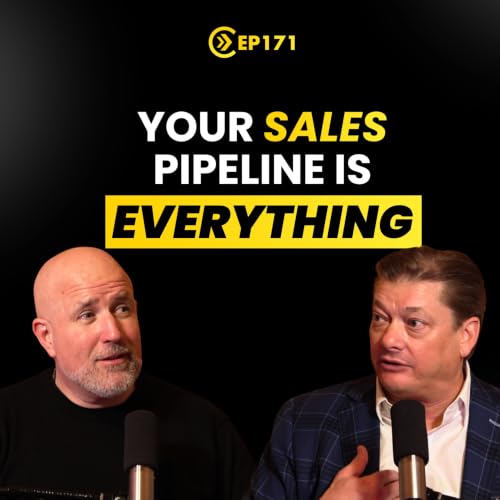
The ActionCOACH Podcast cover art

The ActionCOACH Podcast

The ActionCOACH Podcast

By: James Vincent
Listen for free

The ultimate resource for business owners, leaders, entrepreneurs, and personal development junkies.


This podcast is all about YOU and YOUR success. Bringing the world's best business experts and thought leaders into your environment, giving you the tools and knowledge you need to increase your capability and shape the person you become.


Business Excellence is about taking you to the top of your game and achieving excellence in both business and life.


And we don't just talk the talk – we walk the walk. Powered by ActionCOACH, the World's Number 1 Business Coaching Firm. It’s not about theoretical knowledge – it’s about giving you practical action steps to implement in your business and life right away.


So what are you waiting for? Subscribe to the Business Growth Podcast and enjoy your future success. Prepare to take action, become the person you want to be and attract the business and life you want to have.

Hosted on Acast. See acast.com/privacy for more information.

James Vincent
Economics Leadership Management & Leadership Personal Development Personal Success
Episodes
  • Pipeline is Life: Why Every Entrepreneur Must Become Chief Sales Officer
    Jun 17 2026

    Sales: You're Already Selling (Here's Why That Matters) | Jeb Blount Fanatical Prospecting Author Interview


    Most entrepreneurs think they're not in sales. Jeb Blount knows better. In this backstage episode of the Business Growth Podcast at BizX 2026, we reveal why every business owner must become their company's chief sales officer and how keeping your pipeline full changes everything about how you sell, close, negotiate, and choose customers. Jeb built a 1.2 million-person email list over 20 years, hosts the Sales Gravy podcast (top 10 in its category), and has written 18 bestselling books including Fanatical Prospecting.


    What You'll Learn:


    Why Pipeline Is Life:

    A full pipeline makes you better at every aspect of selling. When you have options, you close better, negotiate stronger, and select the right customers instead of taking anyone who says yes.


    Selling as Consulting:

    The value bridge concept reframes selling from pushing products to guiding people toward their goals. Start with integrity, ask better questions, and position yourself as an interpreter who helps buyers reach their desired future state.


    Multi-Touch Prospecting That Actually Works:

    Phone calls, voicemail, email, LinkedIn messages, in-person visits, newsletters, and podcasts combine to create powerful sequences. Single-channel approaches fail because no one channel works alone anymore.


    Why AI Is Breaking Email:

    Salespeople send 8 times more email than 4 years ago but get one-eighth the results. AI-generated messages have saturated inboxes, forcing email providers to filter aggressively.


    Bold Calling Is Back:

    In-person prospecting is experiencing a resurgence. Jeb shares how he scaled a chain-link fence past 'Beware of Dog' signs, met a business owner, and later closed a $1.2 million deal.


    Key Quotes:


    "Pipeline is life. When you have a full pipeline, you're better at selling, you're better at closing, you're better at negotiating, and you're better at choosing the right customers."


    "Selling is helping people get what they want. If you start with integrity and don't sell people things they don't need, you're just guiding them toward their goals."


    "The phone still works. Nobody answers a phone that doesn't ring. Pick it up."


    Jeb Blount's Background:


    Jeb Blount is a sales trainer, author of Fanatical Prospecting and 17 other bestselling books, and founder of the Sales Gravy podcast (top 10 in its category). He built a 1.2 million-person email list over 20 years and runs a 34-person consulting firm.

    Hosted on Acast. See acast.com/privacy for more information.

    Show More Show Less
    36 mins
  • From 1 Million to Half a Billion: John Hutmacher's Proven System for Scaling Success
    Jun 11 2026

    Hosted on Acast. See acast.com/privacy for more information.

    Show More Show Less
    1 hr and 15 mins
  • Peter Sutcliffe Killed His Mother. He Chose to Help Others | Richard McCann
    Jun 5 2026

    Richard McCann - Peter Sutcliffe Killed His Mother. He Chose to Help Others


    Richard McCann grew up in Scotthall, a deprived area of Leeds, with his mother's alcohol struggles, a violent boyfriend involved in drugs, and constant chaos. Just before his sixth birthday, his mother went out and never came home. At 5:30 the next morning, Richard and his sister Sonia searched for her at a bus stop. Police took them to a children's home: "Mum's been taken to heaven." She'd been murdered by Peter Sutcliffe.


    Six-year-old Richard reframed the tragedy. His mother was no longer suffering. He and his sisters had a fresh start. That survival mechanism -what psychologists call "explanatory style" -kept him afloat for decades. The meaning you apply to a situation creates your reality. But self-doubt followed. He looked in the mirror and saw an "ugly kid." He felt unworthy of relationships or success.


    From age 16, Richard sought relationships to feel worthy. His subconscious didn't believe he deserved them, so he'd self-sabotage. He'd push people away, see things that weren't there, and accuse his girlfriend of being with another guy when she was with a friend. He joined the army and lied about his mother because he was ashamed. They discovered the truth after a year. He was discharged following a drunken rampage. Then came drug dealing, arrest, and imprisonment in the same jail that held Peter Sutcliffe 29 years earlier.


    Rock bottom came after his release in July 1997. He faced house repossession with six weeks to find a job. After five weeks with nothing, he attempted suicide. Nobody would hire him because he had a criminal record.


    What changed? His sister Sonia stabbed her violent boyfriend and faced prison. Richard impulsively decided to write a book to defend her. He had no qualifications but got "Just a Boy" published. The book led to TV appearances and liberated him. He didn't need to be ashamed of his mother's behaviour.


    Speaking invitations followed. He was shocking at first, reading from the book with no understanding of how storytelling works. After two years, he realised he could make more of a difference through speaking than through social work. He was getting letters from people he'd helped.


    Richard discovered that turning trauma into purpose didn't erase the pain. His story became a blueprint for post-traumatic growth -you can grow because of trauma. Lose your job but find work you love. End a relationship, then meet someone you have children with. His workshop helps people identify their first setback and how they grew from it, building belief in their ability to handle future setbacks.


    Today, Richard helps others reframe struggles using his "bounce back graph." You cycle between red (setback) and green (recovery). He teaches that self-doubt can be challenged with evidence. His process: identify thoughts that aren't serving you, write them down, ask "Where's the evidence?" Use the reticular activation system -when you believe something, you see it everywhere. Henry Ford said it: "Whether you believe you can or you can't, you're right."


    His younger sister passed away from lung cancer just before the pandemic. Grief doesn't diminish. But he had belief: "You'll get through this." During the pandemic, his business ground to a halt. He earned £400 in April 2020. Pain and love never disappear because that's part of being human.


    He's written "Teach Me Gently" to help parents support anxious children. His own daughter had six months of school refusal due to anxiety. His key advice: children need to feel safe before any reasoning. When a child is anxious, they're in fight or flight -you can't reason with that. It might take two hours to make them feel safe, but that's the foundation.


    Richard still lives in Leeds. He had mentors like Stuart Hardy, his boss before prison, who gave him belief and treated him like a son. His core message remains simple: the emotional pain of loss never disappears, yet neither do you have to stay in the red.

    Hosted on Acast. See acast.com/privacy for more information.

    Show More Show Less
    32 mins
adbl_web_anon_alc_button_suppression_t1
No reviews yet