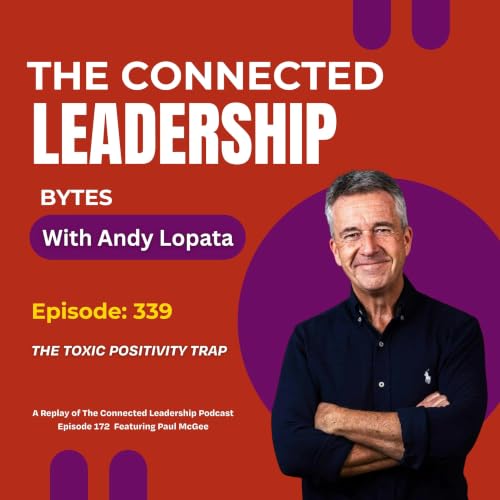
The Connected Leadership Podcast cover art

The Connected Leadership Podcast

The Connected Leadership Podcast

By: Evergreen Podcasts
Listen for free

Speaker and author on professional relationships, Andy Lopata, explores great connections with experts and high achievers worldwide.Andy Lopata, H & A Lopata ltd 2020 Career Success Economics Leadership Management & Leadership
Episodes
  • The Toxic Positivity Trap with Paul McGee
    Jun 29 2026
    Does your pursuit of happiness actually make you miserable? In a world obsessed with Instagram-perfect lives and self-help gurus promising a "magic bullet," it's easy to feel like you are failing if you aren't constantly happy. In this refreshing and deeply honest archive episode, Andy Lopata speaks with Paul McGee (aka "The SUMO Guy"), author of The Happiness Revolution. Bringing his trademark "Mancunian, no-bull" perspective to personal development, Paul dismantles the myth of toxic positivity and the dangerous belief that negative emotions are something to be "fixed." Discover the liberating concept of "Hippo Time," why capitalism thrives on making you feel inadequate, and how the insidious nature of social media comparison is impacting our mental health. This is a vital conversation for anyone who wants to stop faking it and start living a more grounded, authentic, and emotionally agile life. What You Will Learn In This Episode The Instagram Illusion: How the ability to compare our unedited lives with the edited highlight reels of billions of other people is fueling modern unhappiness. The Capitalism of Inadequacy: Why consumer culture relies on the myth that "you are never quite enough" to keep you endlessly searching for happiness in the next purchase. The "Hippo Time" Philosophy: Why giving yourself permission to wallow, feel sad, and digest your disappointment is crucial for long-term emotional resilience. The Danger of the Magic Bullet: Why the self-help industry's promise of a single, easy "fix" for your life is a destructive lie that prevents genuine growth. The Hidden Signs of Struggle: Why we must stop assuming that people who are struggling will ask for help or show obvious warning signs Actionable Insights Audit Your "Mental Diet": Be as conscious of what you feed your mind as what you feed your body. When scrolling through social media (especially the comment sections), actively ask yourself: "Is reading this making me angry or anxious?" If the answer is yes, log off. Protect your mental bandwidth. Embrace "Hippo Time": Stop forcing positivity. When you experience a setback or a low mood, grant yourself a specific, boundaried amount of "Hippo Time" to simply wallow and feel the negative emotion without guilt. Acknowledging the emotion is the first step to processing it and eventually moving on. Ditch the "I'm Fine" Default: If you are struggling, resist the urge to put on a brave face and spout toxic positivity (e.g., "I'm awesome!"). Practice authentic vulnerability with a trusted friend or colleague by admitting when things are tough. You don't have to be broken to ask for support; you just have to be human. SELECTED LINKS FROM THE EPISODE Connect with Andy Lopata: Website | Instagram | LinkedIn | X/Twitter | YouTube Connect with Paul McGee: Website |LinkedIn | The Financial Times Guide to Mentoring Episode 172 Featuring Paul McGee
    Show More Show Less
    22 mins
  • The Mentor, The Coach, and The Sponsor with Vanessa Vallely OBE & Kerrie Dorman
    Jun 22 2026
    Are you trying to advance your career, but unsure who to ask for help? Have you ever wondered if you need a mentor, a coach, or a sponsor—and what the difference actually is? In this episode from the archive, Andy Lopata sits down with two giants of the mentoring world: Vanessa Vallely OBE (founder of WeAreTheCity) and Kerrie Dorman (founder of the Association of Business Mentors). Together, they dismantle the confusion surrounding these crucial professional relationships. Discover the "CCM" approach to support, learn the golden rule that separates a mentor from a sponsor, and find out the exact formula for asking a busy executive to mentor you (without getting a "no"). If you've ever felt stuck in your career, this episode provides the ultimate roadmap for building a "personal boardroom" that will propel you forward. What You Will Learn in This Episode: The "Been There, Done That" Rule: What is the fundamental difference between a coach (who asks questions) and a mentor (who shares scars and experience)? The Talk To vs. Talk About Rule: How to instantly distinguish between a mentor who gives you advice and a sponsor who puts their reputation on the line to get you promoted. The Myth of Age and Rank: Why you don't need to reach a specific level of seniority to deserve a mentor—and why you are actually never too old to have one. The Perfect "Ask": The specific, structured formula you must use when asking someone to be your mentor to guarantee they say "yes." The "Personal Boardroom": Why having just one mentor is a mistake, and how to build an "agile" formula of mentors, coaches, and accountability partners. Actionable Insights Structure Your "Ask": Stop asking people, "Will you be my mentor?" It's too vague and demanding. Instead, use Vanessa’s formula: State why you chose them (flattery helps!), define the specific skill you want to learn, set a clear timeline (e.g., three 30-minute sessions over three months), and define what success looks like. Make it easy for them to say yes. Turn Mentors into Sponsors: A mentor talks to you; a sponsor talks about you in rooms you aren't in. To turn a mentor into a sponsor, you must demonstrate your capability so they feel confident putting their integrity on the line for you. Audit Your "Personal Boardroom": Do not rely on one person for all your professional support. Map out your current network. Do you have an accountability partner who pushes you? Do you have an industry expert who shares their scars? Do you have a coach who asks hard questions? Build a diverse "formula" of mentors to cover your blind spots. SELECTED LINKS FROM THE EPISODE Connect with Andy Lopata: Website | Instagram | LinkedIn | X/Twitter | YouTube Connect with Vanessa Vallely OBE: Website |LinkedIn | Connect with Kerrie Dorman: Website |LinkedIn | The Financial Times Guide to Mentoring Episode Featuring Vanessa & Kerrie
    Show More Show Less
    24 mins
  • A Hand Up, Not a Hand Out with Nigel Kershaw OBE
    Jun 15 2026
    When The Big Issue launched in 1991, it didn't just introduce a new publication; it fundamentally changed the face of homelessness. By offering a "hand up, not a hand out," it turned vulnerable individuals into micro-entrepreneurs and challenged the traditional charity model. In this inspiring episode from the archive, Andy Lopata speaks with Nigel Kershaw, Chairman of The Big Issue Group, about the incredible 30-year journey of this iconic social enterprise. Nigel shares the origin story—sparked by an encounter on the streets of New York—and the initial pushback they faced from both the homeless community and established charities. Discover how The Big Issue built a powerful, interdependent relationship with its vendors, the critical pivot they made overnight during the pandemic lockdown, and how a "mad idea" to start a social merchant bank led to managing £300 million in impact funds. This is a masterclass in leading with purpose, scaling impact, and proving that business solutions can solve social crises. What you will learn in this episode: The Origin Story: How a chance encounter with a "two-time loser from upstate New York" inspired the creation of one of the world's most successful social enterprises. The Business of Prevention: Why The Big Issue was strictly structured as a business, not a charity, and the initial resistance they faced from both charities and homeless individuals. The Interdependent Relationship: How the dynamic between The Big Issue and its vendors differs entirely from the traditional "giver and receiver" charity model. Actionable Insights: Build Interdependent Relationships: Move away from purely transactional or paternalistic relationships with your stakeholders. The Big Issue succeeds because the business needs the vendors to sell, and the vendors need the business for stock. Create structures where your success is directly tied to the success of your partners. Incubate Radical Ideas Separately: When you have a disruptive or highly innovative idea, don't force it onto a core team that is already busy managing day-to-day operations. Like The Big Issue did with their investment arm, incubate these ideas outside the main structure to allow them space to grow without facing immediate resistance or resource constraints. Use Crises to Force Digital Transformation: When the pandemic wiped out their street sales overnight, The Big Issue didn't just ask for donations; they accelerated a planned digital pivot, introducing cashless sales and digital wallets. Use major disruptions as a catalyst to push through necessary innovations that might otherwise take years to implement. SELECTED LINKS FROM THE EPISODE Connect with Andy Lopata: Website | Instagram | LinkedIn | X/Twitter | YouTube Connect with Nigel Kershaw OBE: Website |LinkedIn | The Financial Times Guide to Mentoring Episode 173 Featuring Nigel Kershaw OBE
    Show More Show Less
    22 mins
adbl_web_anon_alc_button_suppression_t1
No reviews yet