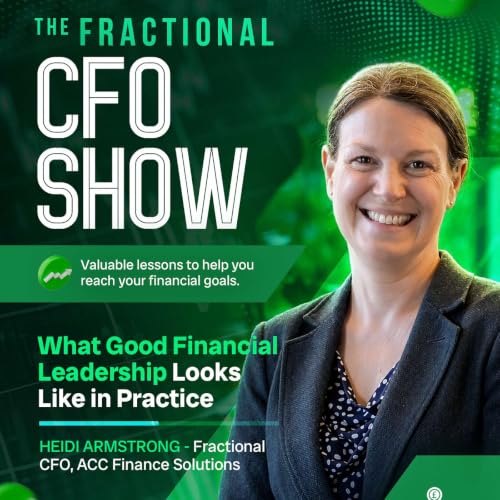
The Fractional CFO Show with Adam Cooper cover art

The Fractional CFO Show with Adam Cooper

The Fractional CFO Show with Adam Cooper

By: Adam Cooper
Listen for free

Every small business owner needs financial advice to help scale and grow. Each week successful Operators join fractional CFO Adam Cooper, to share their experiences, tips and tricks to help improve your business cash flows, profits and help reach your financial goals. If you are an entrepreneur looking to take control of your business finances, this is the podcast for you.

© 2026 The Fractional CFO Show with Adam Cooper
Economics Leadership Management Management & Leadership
Episodes
  • What Good Financial Leadership Looks Like in Practice
    Jun 17 2026
    What does good financial leadership actually look like inside a growing business?Many founders reach a point where bookkeeping is under control, management accounts are being produced, and year-end compliance is taken care of, yet they still feel uncertain when making important business decisions.They know the numbers exist.They receive reports.They have visibility of revenue.But they still don't feel fully in control of profitability, cash flow, hiring decisions, pricing, or growth plans.In this episode of The Fractional CFO Show, Adam Cooper is joined by Heidi Armstrong, Fractional CFO at ACC Finance Solutions, for a practical discussion about the role financial leadership plays in helping founder-led businesses improve profitability, strengthen cash flow, and make better decisions.This is a particularly special episode as it marks the first time a member of the ACC Finance Solutions team has joined the show.Drawing on her experience working with businesses across recruitment, beauty, media, professional services and other founder-led organisations, Heidi shares what she sees when businesses begin to outgrow basic finance support and require more strategic financial guidance.The conversation explores a common challenge faced by many SMEs.Business owners often know they need "better finance", but they're not always sure what that means in practice.Is it better reporting?More detailed management accounts?A bigger finance team?More software?Or is it something else entirely?Throughout the discussion, Heidi explains why good financial leadership is often less about producing more reports and more about helping business owners understand what their numbers are telling them and how those insights should influence future decisions.Topics covered include:• What a Fractional CFO actually does within a growing business• Why many founders feel disconnected from their numbers despite receiving regular financial reports• The difference between financial reporting and financial leadership• How financial forecasting helps business owners make decisions with greater confidence• The role of cash flow forecasting in supporting sustainable growth• Why revenue growth does not always lead to improved profitability• How management information can become a genuine decision-making tool• The importance of monitoring financial KPIs that actually matter• Common reasons margins deteriorate without founders noticing• Why pricing reviews should be a regular business discipline• The impact of inflation, supplier costs and overhead increases on profitability• How hiring decisions affect cash flow, capacity and future growth• The financial implications of expanding too quickly• Why business owners should place a value on their own time• How scenario planning supports better strategic decisions• The hidden cost of difficult clients• Why client profitability is about more than revenue alone• Lessons learned from working across multiple industries and business modelsOne of the most interesting parts of the conversation centres on client profitability.Many business owners evaluate clients purely based on the revenue they generate.However, Heidi discusses why some clients can consume disproportionate amounts of management time, operational resources and emotional energy.A client may appear profitable on paper but become significantly less attractive once the true cost of servicing them is taken into account.The discussion highlights why founders should regularly assess not only what clients pay but also the time, complexity, interruptions and stress associated with managing those relationships.The episode also explores the connection between financial visibility and confidence.When founders lack clarity around cash flow, profitability or future financial performance, decision-making often becomes reactive.Businesses delay investments.Hiring decisions become difficult.Growth opportunities are missed.Cash flow concerns create unnecessary stress.By contrast, businesses that embrace financial forecasting, scenario planning and regular performance reviews are often able to make decisions earlier, with greater certainty and lower risk.Heidi shares practical examples of how she helps business owners understand the numbers behind their businesses, identify potential issues before they become serious problems, and create financial plans that support both growth and profitability.The conversation also touches on a challenge many founders face but rarely discuss openly: the value of their own time.Business owners frequently make decisions without fully considering the opportunity cost of their involvement.Tasks that appear profitable on paper can become far less attractive when the founder's time is properly valued.Understanding this often changes how businesses think about delegation, recruitment, pricing and operational structure.Whether you're running a recruitment business, professional services firm, agency, ...
    Show More Show Less
    38 mins
  • Building Without Funding: Control, Trade-offs, and Discipline
    Jun 4 2026
    Building Without Funding: Control, Trade-offs, and Capital DisciplineWhat if the best source of funding for your business isn't an investor?What if it's your customers?In this episode of The Fractional CFO Show, Adam Cooper sits down with Tayfun Bilsel, founder and CEO of Clinked, to explore the realities of building and scaling a technology business without relying on external investment.Over the last two decades, the startup world has become heavily associated with fundraising, venture capital, angel investors and rapid growth. Raising capital is often presented as the natural next step for ambitious founders.Tayfun's journey offers a different perspective.Since launching Clinked in 2008, Tayfun has grown the business into a leading client portal and business collaboration platform serving thousands of customers across more than 40 countries worldwide. Yet much of that growth has been achieved without the traditional venture-backed route.Instead, Clinked was built through customer revenue, careful resource allocation, financial discipline and a relentless focus on solving real customer problems.In this conversation, Adam and Tayfun discuss how operating without external funding changes the way founders think about growth, risk, profitability, customer acquisition and long-term decision making.One of the most interesting parts of the discussion centres around the concept of customer-funded growth.Rather than building products in isolation and hoping the market would eventually respond, Clinked's early development was heavily influenced by real customer feedback. In some cases, customers even helped fund specific product features, creating an additional layer of market validation before development resources were committed.The result was a business built around genuine customer demand rather than assumptions.The conversation explores how this approach helped create focus, prioritisation and commercial discipline during the early stages of growth.Topics covered include:• Why Tayfun initially chose not to pursue external investment• The realities of building a SaaS business during the 2008 financial crisis• Customer-funded growth and product validation• How early customers shaped Clinked's development• The importance of product-market fit• Financial discipline and capital efficiency• Managing cash flow without a financial safety net• Resource allocation when every investment decision matters• Customer acquisition versus customer retention• Why recurring revenue became a strategic advantage• Growth under constraint and the benefits of limited resources• Long-term thinking versus short-term investor expectations• Building sustainable growth models• The relationship between profitability and growth• Risk management for founder-led businesses• Scaling internationally without venture capital• Customer success as a growth strategy• Decision-making under uncertainty• The trade-offs between speed, ownership and control• When founders should consider raising investment• Common fundraising mistakes made by growing businessesThroughout the discussion, Tayfun shares practical lessons from nearly 18 years of building and growing Clinked through multiple economic cycles, changing technology trends and shifting market conditions.One recurring theme is the value of staying close to customers.As Clinked grew, the business continued to prioritise customer feedback, customer success and customer relationships. Tayfun explains how maintaining direct contact with customers helped the company make better decisions, identify opportunities faster and avoid many of the distractions that can come from chasing vanity metrics or short-term growth targets.The episode also explores the financial realities of building a company without access to large amounts of external capital.Without investor money acting as a buffer, cash flow management becomes critical. Every hiring decision, product investment, marketing initiative and growth opportunity must be assessed through the lens of sustainability and long-term value creation.For finance leaders, CFOs and operators, the discussion offers valuable insight into capital allocation, customer economics, resource prioritisation and strategic planning.For founders and entrepreneurs, it provides a candid look at the challenges and rewards of building a business where customer value, profitability and sustainable growth take priority over fundraising headlines.One particularly valuable section of the episode focuses on the question many founders face:"When should you actually raise capital?"Tayfun shares his view that investment should generally follow validation rather than precede it. Before raising money, founders should understand their market, prove customer demand, establish repeatable growth mechanisms and gain confidence that additional capital can generate a meaningful return.Rather than raising money simply because funding is available, he ...
    Show More Show Less
    29 mins
  • Why Forecasting Revenue Is So Hard
    May 14 2026

    Why is revenue forecasting so difficult in agencies and project-based businesses?

    In this episode of The Fractional CFO Show, Adam Cooper speaks with Julia Longo, Group Finance Director at SAENTYS, about the operational and financial realities of forecasting revenue in a fast-moving creative consultancy environment.

    SAENTYS operates across the UK, France and Switzerland, supporting clients in the real estate, hospitality and destination sectors. Julia oversees finance across multiple entities and shares a practical, experience-led view of how forecasting, reporting and operational planning work inside an international agency business.

    The discussion explores the difference between billing forecasting and revenue forecasting, and why many businesses have strong visibility over invoicing and pipeline activity but still struggle to understand future profitability and utilisation properly.

    Adam and Julia discuss the challenges of managing constantly shifting project scopes, changing client deadlines, freelancer requirements and resource allocation, all while trying to maintain accurate financial reporting and forward-looking visibility.

    The episode also covers the importance of management accounts, KPI reporting, operational finance processes and cross-functional collaboration between finance, client services, operations and creative teams.

    Other topics covered include:

    • Revenue forecasting vs billing forecasting
    • Financial planning in project-based businesses
    • Profitability management for agencies
    • Cash flow forecasting and pipeline visibility
    • Resource planning and utilisation management
    • PSA systems and operational reporting
    • Finance leadership in creative businesses
    • International reporting and multi-entity finance operations
    • Forecasting challenges in professional services firms
    • Improving financial visibility through better systems and processes
    • Time tracking, project profitability and operational accountability
    • Management reporting for growing agencies
    • Finance transformation and process improvement
    • Forecasting uncertainty and decision-making with incomplete data
    • The role of finance in supporting operational performance

    Julia also shares insights from her non-traditional route into finance leadership, moving from a background in chemistry and operations into senior finance roles within the agency world. The conversation highlights why strong finance leaders in creative and professional services businesses need commercial awareness, operational understanding and the ability to work closely with non-finance teams.

    This is a practical conversation for agency founders, finance directors, COOs, management accountants, project-based businesses and professional services firms looking to improve forecasting accuracy, profitability, financial visibility and operational decision-making.

    Guest:
    Julia Longo - Group Finance Director at SAENTYS

    Hosted by:
    Adam Cooper - ACC Finance Solutions

    Listen on Spotify, Apple Podcasts and all major podcast platforms.

    #FinancialForecasting #RevenueForecasting #ManagementAccounts #CashFlowForecasting #Profitability #AgencyFinance #FinanceLeadership #OperationalFinance #ProfessionalServices #BusinessGrowth

    Show More Show Less
    33 mins
adbl_web_anon_alc_button_suppression_t1
No reviews yet