Episodes

  • An Intimate Spanish Wine Tasting with Viña Memorias
    Jun 25 2026

    Send a Text Message to The Kosher Terroir

    Old vines. High altitude. Native Spanish grapes. If those words grab you, pour a glass and come with us to Valencia, where winemaker Armando from Viña Memorias walks us through a kosher wine tasting that’s equal parts sensory and deeply practical. We’re chasing a specific style: kosher wines that stay light on their feet without losing structure, and wines that make sense in hot weather because they’re built for it.

    We get into why Bobal from older vineyards tends toward larger clusters, greater ripeness, and a more elegant feel, plus how climate and large day-night temperature swings in Utiel-Requena can preserve acidity and help keep alcohol levels in check. On the white side, we explore Macabeo and its many identities across Spain, how blending choices change with the vintage, and why stainless steel “inox” is a deliberate move to protect fruit and freshness. We also talk about release timing and why letting wines rest in the bottle can be the difference between sharp and seamless.

    Then we go deeper into technique and tradition: clay tinajas versus oak, micro-oxygenation without wood flavors, lees aging and batonnage for texture, and why some Spanish wine classifications like crianza and reserva often communicate aging time more than quality. We finish with traditional-method sparkling Macabeo and a surprisingly useful tasting ritual that starts with bubble quality before you even chase aromas.

    If you care about Spanish kosher wine, terroir, old vines, and the real decisions behind “minimal intervention,” this one is for you. Subscribe, share it with a wine-loving friend, and leave a review so more people can find the show.

    Support the show

    www.TheKosherTerroir.com
    +972-58-731-1567
    +1212-999-4444
    TheKosherTerroir@gmail.com
    Link to Join “The Kosher Terroir” WhatsApp Chat
    https://chat.whatsapp.com/EHmgm2u5lQW9VMzhnoM7C9
    Thursdays 6:30pm Eastern Time on the NSN Network and the NSN App

    Show More Show Less
    1 hr and 2 mins
  • Mevushal - Boiled not Spoiled
    Jun 18 2026

    Send a Text Message to The Kosher Terroir

    We boil wine on purpose and then argue about whether it’s ruined. That tension sits at the heart of mevushal, the “cooked” kosher wine category that some drinkers dismiss, some skeptics call a loophole, and every caterer quietly relies on to make a wedding run. From Jerusalem, I walk you through why Jewish law treats wine differently from almost every other food: a bottle can be perfectly kosher by ingredients and still change status based only on who touches it.

    We put the law and the wine on the same table. I trace the Talmudic roots of the handling restriction, then unpack three competing explanations for why cooked wine is exempt. Those “whys” lead straight into the modern fight over what cooked even means, from boiling reduction to Rav Moshe Feinstein’s yad soledet bo threshold around 175°F, and the objections that demand a noticeable change in taste, aroma, or color. Once flash pasteurization enters the picture, one sealed machine can produce three very different halachic outcomes.

    Then we go to the cellar and ask what heat actually does. Pasteurization can deliver microbial stability, protein stability, and consistency for shipping and events, which matters for kosher wine at scale. But there’s a bill: aromatic compounds like terpenes can drop, ester profiles can shift, and aging potential may narrow, especially for serious whites and cellar-worthy reds. A final curveball using brandy and distillation shows what cooking can protect going forward and what it can never “fix” after the fact.

    If you’ve ever wondered whether mevushal is lesser or simply different, you’ll leave with a clearer framework for choosing the right bottle for the right job. Subscribe, share this with a friend who refuses to drink cooked wine, and leave a review so more people find Kosher Terroir.

    Support the show

    www.TheKosherTerroir.com
    +972-58-731-1567
    +1212-999-4444
    TheKosherTerroir@gmail.com
    Link to Join “The Kosher Terroir” WhatsApp Chat
    https://chat.whatsapp.com/EHmgm2u5lQW9VMzhnoM7C9
    Thursdays 6:30pm Eastern Time on the NSN Network and the NSN App

    Show More Show Less
    1 hr and 7 mins
  • Summer Wine Heresies
    Jun 10 2026

    Send a Text Message to The Kosher Terroir

    You’re about to watch a wine snob inside your head lose the argument, one delicious “heresy” at a time. From Jerusalem, I’m Simon Jacob, and I’m making the case that the most respectful way to love wine is to use the right bottle for the right moment, including the messy, loud, sun-soaked moments where pitchers and ice belong on the table. Yes, we even go straight at the taboo: cola in red wine, and why it’s technically defensible.

    We start by drawing a clean line between ageworthy “library bottles” and bright, cheerful wines that are built to be mixed. Then I give you a simple shopping checklist for the best summer wine cocktails: high acidity, fruit-forward flavor, low oak, modest alcohol, soft tannins for reds, and a price that keeps the whole thing honest. If you drink kosher, this is a golden era. Crisp, high-acid kosher rosé and unoaked whites are everywhere, and we talk about why Mavushal wine can be a real advantage when the pitcher is getting passed around at a party.

    Then we taste four styles of wine as foundations and build five drinks you can actually host with: an honest spritz where the wine leads, a white peach and thyme sangria that gets better overnight, the Basque classic Kalimotxo, a real-deal frose with the food science that makes it silky, and a low-alcohol wine highball for long afternoons. I tie it together with one formula you can memorize so you can invent endlessly without clinging to recipes.

    Make your own house sangria and tell me what you built, then subscribe, share the episode with your summer-host friend, and leave a review so more people find the show.

    Support the show

    www.TheKosherTerroir.com
    +972-58-731-1567
    +1212-999-4444
    TheKosherTerroir@gmail.com
    Link to Join “The Kosher Terroir” WhatsApp Chat
    https://chat.whatsapp.com/EHmgm2u5lQW9VMzhnoM7C9
    Thursdays 6:30pm Eastern Time on the NSN Network and the NSN App

    Show More Show Less
    53 mins
  • Whats in a Nickname?
    Jun 4 2026

    Send a Text Message to The Kosher Terroir

    A masked man on the cover of Wine Spectator helps spark a revolution, and that single image becomes our doorway into a bigger claim: every famous wine rebellion has a kosher twin, and sometimes the kosher world gets there first. From Jerusalem, I take you on a guided tour through the nicknames that built modern wine culture and use each one to ask the question nobody seems to ask out loud: where is the kosher version of this story?

    We start with California’s Rhone Rangers and the permission structure they created beyond Cabernet Sauvignon and Chardonnay, then follow the kosher trail to Paso Robles and Napa through producers like Shirah, Jonathan Hajdu, and Covenant. We zoom out to Cal Ital and the under-told kosher workarounds: Sangiovese and the stubborn, rare beauty of kosher Nebbiolo. Then we head to Italy, where Super Tuscans and Barolo modernists rewrote the rules, and we meet Dr. Ralph Medeb, the Brooklyn “Wine Doctor” whose commissioning model helps bring serious kosher Barbera, Aglianico, Nebbiolo, and even top-tier Brunello di Montalcino into the conversation. I also spotlight Jewish-owned Tuscan estates proving kosher can be built from the ground up.

    From there, we connect kosher wine to the global engine of flying winemakers, the gritty genius of the garagiste model, and the quiet miracle of kosher Bordeaux, including the kind of bottles collectors whisper about. Spain rounds out the European arc with a Catalan cooperative’s leap into kosher production and the rise of Elvi Wines across multiple Spanish appellations. Finally, we come home to Israel, where Mediterranean varieties and revived indigenous grapes like Marawi and Bittuni point to something new, a movement I name the Sabraistas.

    If you’ve ever wondered whether kosher wine can be truly world-class, this story is your map. Subscribe, share this with a wine friend, and leave a review so more people find the kosher wine world that’s been hiding in plain sight.

    Support the show

    www.TheKosherTerroir.com
    +972-58-731-1567
    +1212-999-4444
    TheKosherTerroir@gmail.com
    Link to Join “The Kosher Terroir” WhatsApp Chat
    https://chat.whatsapp.com/EHmgm2u5lQW9VMzhnoM7C9
    Thursdays 6:30pm Eastern Time on the NSN Network and the NSN App

    Show More Show Less
    1 hr and 18 mins
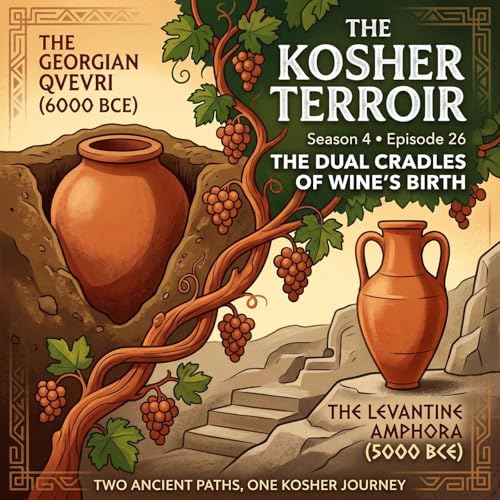
  • The Dual Cradles of Wines Birth
    May 27 2026

    Send a Text Message to The Kosher Terroir

    A friend brings me a heavy bottle from Georgia, and the first thing it teaches us is that weight can be a message. When I pour the wine, the color is almost opaque, purple-black with a stained magenta rim, and it becomes a clue that leads straight into one of the oldest winemaking traditions on Earth: Georgian qvevri wine, fermented and aged in an egg-shaped clay vessel buried in the ground.

    From there, I take you back to archaeology and scripture, because Georgia and the land of Israel are both ancient wine civilizations with receipts. We look at the evidence for Georgia as the cradle of wine, then travel south to Israel’s rock-carved winepresses, the Tel Kabri royal wine cellar, and the amphora economy that turned wine into a Mediterranean export. One culture buries its clay and lets the earth act as a thermostat. The other puts handles on clay, seals it, labels it, and sends it out to sea.

    Then we put the two approaches head to head: heat and oxygen, preservation with resins and sweetness, and the difference between oxidation as a flaw and oxidative style as a choice. Finally, we bring it home through a kosher lens, where wine is holy in Jewish life and kashrut depends on who handles it. I also tackle the real history behind sweet Kiddush wine, including what’s ancient, what’s American, and what’s myth.

    If you like wine history, natural wine, Georgian Saperavi, ancient Israel, amphora aging, or kosher wine, you’ll leave with a new way to taste what’s in your glass. Subscribe, share this with a friend who would love it, and if you can, leave a rating or review so more people can find the show.

    Support the show

    www.TheKosherTerroir.com
    +972-58-731-1567
    +1212-999-4444
    TheKosherTerroir@gmail.com
    Link to Join “The Kosher Terroir” WhatsApp Chat
    https://chat.whatsapp.com/EHmgm2u5lQW9VMzhnoM7C9
    Thursdays 6:30pm Eastern Time on the NSN Network and the NSN App

    Show More Show Less
    1 hr and 19 mins
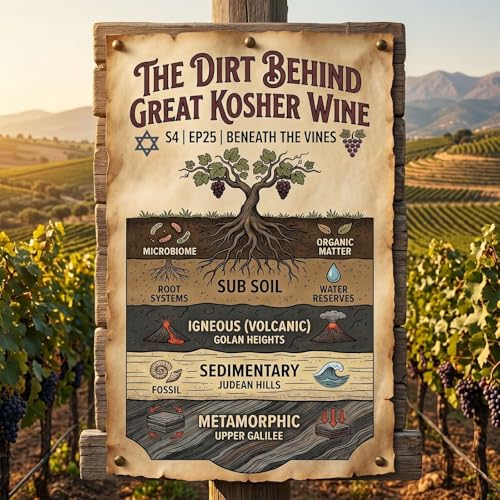
  • The Dirt Behind Great Kosher Wine
    May 20 2026

    Send a Text Message to The Kosher Terroir

    You can watch a winemaker in a vineyard for five minutes and learn the real secret: they don’t spend most of their time looking at the grapes. They look down at the dirt. From Jerusalem, I’m taking you underground to the place where kosher wine is actually made, in the topsoil, subsoil, bedrock, and the living microbiome that turns geology into something you can feel on your tongue.

    We walk through the vineyard’s layers, then travel across the three rock families. Volcanic igneous soils like the basalt of the Golan Heights. Sedimentary limestone and chalk, like what you find in the Judean Hill, and Metamorphic slate and schist in Spain and Germany.

    To make it practical, I give you a simple side by side tasting to try on Shabbat so you can learn to taste terroir as texture and structure, not just flavor notes.

    If this opened your eyes to looking down at the dirt the next time you pour a glass of wine, please subscribe, share with a fellow wine geek, and leave a review so more people can find Kosher Terroir.

    Support the show

    www.TheKosherTerroir.com
    +972-58-731-1567
    +1212-999-4444
    TheKosherTerroir@gmail.com
    Link to Join “The Kosher Terroir” WhatsApp Chat
    https://chat.whatsapp.com/EHmgm2u5lQW9VMzhnoM7C9
    Thursdays 6:30pm Eastern Time on the NSN Network and the NSN App

    Show More Show Less
    44 mins
  • KFWE Tel Aviv 2026
    May 14 2026

    Send a Text Message to The Kosher Terroir

    Most people have a “kosher wine” picture stuck in their head: sweet, syrupy, and only for ritual use. From the floor of a live kosher wine tasting, we go straight at that stereotype by asking winemakers, importers, and wine pros to name the one myth they’d love to kill and then proving the point with specific bottles, regions, and real production details.

    We talk about what actually drives quality: where the grapes come from, how the vintner works, and why a great kosher wine can be every bit as compelling as a great non-kosher wine. Along the way we pour a rich Chardonnay with serious California pedigree and use it as a reminder that “kosher” is a certification, not a flavor. Several guests also tackle the debates people argue about most, especially Mevushal: what it is today, what it might do to aging, and why modern methods are nothing like the scary “boiled wine” shorthand.

    The myths get more practical and more human as the microphones move: kosher wine doesn’t have to be expensive, supervision isn’t a constant obstacle to winemaking, and you don’t need a rabbi to bless your bottle. We even get one of the best pieces of drinking advice you’ll hear all week: you shouldn’t feel pressured to finish an opened bottle the same day, and some wines reward patience. Finally, we zoom out to what’s changing fast such as rising Israeli wine quality, greater attention to appellation and winery story, and the outdated idea that women can’t be winemakers in the kosher wine world.

    If you like wine education without the snobbery, hit subscribe, share this with a friend who still thinks kosher means sweet, and leave a review so more people can find the show. Which kosher wine myth have you heard most often?

    Support the show

    www.TheKosherTerroir.com
    +972-58-731-1567
    +1212-999-4444
    TheKosherTerroir@gmail.com
    Link to Join “The Kosher Terroir” WhatsApp Chat
    https://chat.whatsapp.com/EHmgm2u5lQW9VMzhnoM7C9
    Thursdays 6:30pm Eastern Time on the NSN Network and the NSN App

    Show More Show Less
    37 mins
  • The ABC's of Chardonnay Reconsidered
    May 7 2026

    Send a Text Message to The Kosher Terroir

    Chardonnay has been mislabeled as predictable for so long that a lot of wine lovers stopped tasting it with fresh eyes. We’re changing that by treating Chardonnay like what it really is: a translator for place and a scoreboard for decisions in the cellar. From my window in Jerusalem, we trace how limestone, clay, and volcanic basalt can reshape the same grape into radically different expressions, whether it’s a mineral-driven Judean Hills white or a fog-cooled California bottle from Russian River Valley or Chalk Hill.

    We dig into the story behind the grape, from its surprising DNA parentage to the way Burgundy’s monks “mapped” terroir long before modern lab tools. Then we step into the winery to unpack the real mechanics behind Chardonnay style: malolactic fermentation and the buttery diacetyl debate, French vs American oak, the rise of unoaked “naked Chardonnay,” and bâtonnage for that savory, leesy weight. If you’ve ever wondered why one Chardonnay tastes like flint and another like popcorn, you’ll leave with a clear framework and practical shopping cues.

    The kosher wine journey is front and center. We talk about the cold-tech revolution that helped kosher Chardonnay leap in quality, from the Golan Heights’ high-altitude vineyards and stainless steel fermentation control to California pioneers who refused to treat “kosher” as a compromise. Along the way we revisit the Judgment of Paris and the 1990s butter-bomb backlash, then reveal Chardonnay’s secret superpower in Blanc de Blancs sparkling wine, where acidity and patience create some of the most age-worthy bottles on earth.

    If you care about terroir, kosher wine, Israeli wine, California Chardonnay, or simply drinking smarter, press play and taste Chardonnay as a living narrative again. Subscribe, share this with your biggest ABC friend, and leave a review with your go-to style: flinty and lean, creamy and layered, or sparkling Blanc de Blancs?

    Support the show

    www.TheKosherTerroir.com
    +972-58-731-1567
    +1212-999-4444
    TheKosherTerroir@gmail.com
    Link to Join “The Kosher Terroir” WhatsApp Chat
    https://chat.whatsapp.com/EHmgm2u5lQW9VMzhnoM7C9
    Thursdays 6:30pm Eastern Time on the NSN Network and the NSN App

    Show More Show Less
    46 mins