• Episode 067: Menopause, Meet Your New Natural Health App
    Jun 3 2026

    You can Google a menopause symptom in five seconds and still feel more confused than when you started. That’s the tension we’re living in: unlimited information, limited clarity, and almost no time to sort what’s credible, what’s safe, and what actually fits our bodies. So when we heard about Natura AI, a natural health AI built to remember you, we wanted to know what it really is and what it isn’t.

    We’re joined by co-founders Nate and Callie for a candid, practical conversation about how their personalized AI health app works, why they built it, and how it’s different from a generic chatbot. We dig into the intake process that creates a long-term health profile, how the model uses that context to tailor answers, and why that matters for midlife women navigating perimenopause and menopause. Think hormone shifts, sleep disruption, night sweats, anxiety, supplement questions, and potential interactions, all changing over time.

    We also pressure-test the hard parts: validating sources, safety guardrails, and the boundaries between education and medical care. Then we run a live example for waking up at 3 a.m. with a racing heart and stress, and talk through how features like voice input, photo ingredient scanning, and Apple Health integration make this feel usable in real life. Finally, we get direct about data privacy, encryption, and why they refuse sponsors and won’t sell user data.

    If you’re trying to make confident decisions about natural health, hormone support, and midlife wellness without spending hours in a research rabbit hole, this one is for you. Subscribe, share it with a friend, and leave a review so more women can find the show.

    Websites:

    NaturaAI: www.mynatura.ai

    Website: https://www.midovia.com/
    Instagram: https://www.instagram.com/mymidovia
    LinkedIn: http://www.linkedin.com/midovia
    Email Us: info@midovia.com

    MiDOViA is dedicated to changing the narrative about menopause by educating, raising awareness & supporting women in this stage of life, both at home and in the workplace. Visit midovia.com to learn more.

    The information, including but not limited to, text, graphics, images & other material contained on this website are for informational purposes only. No material on this site is intended to be a substitute for professional medical advice, diagnosis or treatment.

    Show More Show Less
    40 mins
  • Episode 066: Menstrual Health Across the Lifespan
    May 28 2026

    If you’ve ever been told to “push through” your period pain, heavy bleeding, or sudden mood swings, we want to give you a better baseline and better language for getting help. We’re sharing a Menstrual Hygiene Day webinar replay with Dr. Dombo, a board-certified OB-GYN and menopause-certified practitioner with a cross-cultural lens on how women experience periods, stigma, and care gaps.

    We break down the menstrual cycle in plain terms (follicular phase, ovulation, luteal phase) and connect estrogen and progesterone changes to real symptoms that show up at home and at work. We also get specific about what isn’t normal: soaking through pads or tampons hourly, bleeding longer than seven days, or cramps that regularly derail school, work, or life. Dr. Dombo explains how conditions like fibroids, endometriosis, thyroid issues, and clotting disorders can hide behind “it’s just my period,” and why racial and ethnic disparities lead to delayed diagnosis for too many women.

    From there, we zoom out to perimenopause and the menopause transition, including why symptoms can ramp up even when your periods still look “regular.” Sleep disruption, brain fog, anxiety, shifts in libido, vaginal dryness, bladder changes, and even dry eyes can be part of the picture, and hormones can deeply affect mental health through neurotransmitters like serotonin and dopamine.

    We end with practical self-advocacy: track your cycle and symptoms for three months, name details with clarity, and consider telehealth options like Alloy Health to expand access while still partnering with your local clinician. Subscribe, share this with a friend, and leave a review so more people stop normalizing suffering and start getting answers.

    Websites:

    www.myalloy.com

    NaturaAI: www.mynatura.ai

    Website: https://www.midovia.com/
    Instagram: https://www.instagram.com/mymidovia
    LinkedIn: http://www.linkedin.com/midovia
    Email Us: info@midovia.com

    MiDOViA is dedicated to changing the narrative about menopause by educating, raising awareness & supporting women in this stage of life, both at home and in the workplace. Visit midovia.com to learn more.

    The information, including but not limited to, text, graphics, images & other material contained on this website are for informational purposes only. No material on this site is intended to be a substitute for professional medical advice, diagnosis or treatment.

    Show More Show Less
    50 mins
  • Episode 065: Three Small Changes Can Make A Workplace Period Positive
    May 22 2026

    Half the workforce menstruates, but most workplaces still operate as if periods never happen. That silence shows up in the worst moments: a surprise bleed, no supplies, no private place to manage it, and the scramble to get through a meeting or a full shift while hoping nobody notices. We talk candidly about why this gap persists and what it costs employees and employers, especially during perimenopause when cycles can turn unpredictable and heavy.

    I’m joined by Diana Nelson, Advocacy Director at Days for Girls International and a leader behind the Period Positive Workplace initiative. She explains how the menstrual health conversation has evolved from a narrow focus on products and girls in school to a more holistic approach that includes wash facilities, accurate education, pain management, and the full life cycle from menstruation to menopause. We also dig into the practical reality of humanitarian and disaster relief and why “product choice” matters for dignity and real-world needs.

    Then we get concrete. Period Positive Workplace asks organizations to do three things: provide free menstrual products, ensure a space where people can manage their period with privacy and basic amenities, and communicate clearly that this support exists. Diana shares impact data showing how quickly these small changes open new conversations and reduce stress, plus why the ROI can be significant when you account for hidden costs like absenteeism, reduced productivity, and leaving work to buy supplies.

    If you want a simple, measurable way to support menstrual health at work, this conversation gives you a starting point and the language to lead. Subscribe, share this with a manager or HR partner, and leave a review so more workplaces stop treating menstrual health like a taboo and start treating it like a normal human need.

    Websites:

    https://www.https://www.periodpositiveworkplace.org/

    https://www.daysforgirls.org

    Cozy Earth: www.cozyearth.com

    20% OFF Discount Code: MIDOVIA

    MiDOViA LINKS:

    Website: https://www.midovia.com/
    Instagram: https://www.instagram.com/mymidovia
    LinkedIn: http://www.linkedin.com/midovia
    Email Us: info@midovia.com

    MiDOViA is dedicated to changing the narrative about menopause by educating, raising awareness & supporting women in this stage of life, both at home and in the workplace. Visit midovia.com to learn more.

    The information, including but not limited to, text, graphics, images & other material contained on this website are for informational purposes only. No material on this site is intended to be a substitute for professional medical advice, diagnosis or treatment.

    Show More Show Less
    38 mins
  • Episode 064: How To Rebuild Your Health In Menopause
    May 12 2026

    Most women hit midlife doing the “right” things and still feel worse: the same meals, the same workouts, the same hustle, and suddenly the results disappear. That’s not failure, it’s math. Your health equation changes in perimenopause and menopause, and trying to force your old inputs to produce old outputs is where frustration and burnout take over.

    We sit down with Jill Foos, founder of Jill Foos Wellness and host of the Health Trip Podcast, to talk about what’s really happening beneath the surface and what actually helps in real life. We get into why so many women arrive after seeing multiple doctors, exhausted but still curious, and how Jill helps them start again without the overwhelm. We talk protein and strength training, the intimidation factor that keeps women from lifting, and how to lower the barrier to entry so progress feels doable instead of impossible.

    Then we go deeper into the biology and the mindset shift. Jill breaks down how changing estrogen, progesterone, and testosterone can influence sleep, mood, motivation, and libido, plus why muscle loss is often about aging, not just hormones. We also talk about grieving your old body and identity, using a clear vision for your 70s and 80s as motivation, and becoming the CEO of your healthcare by building a real team you can trust and, when needed, replacing providers who dismiss you.

    If you want a smarter, more sustainable menopause plan built around your life, not a one-size-fits-all protocol, press play. Subscribe, share with a friend who’s struggling, and leave a review so more women can find this conversation.

    Jill Foos is a National Board Certified Health and Wellness Coach based in Chicago who is skilled in evidence-based strategies for behavior change and is a member of MINT (Motivational Interviewing Network of Trainers). She holds certifications from the Institute for Integrative Nutrition and the Functional Medicine Coaching Academy and has specialized training in
    menopause, mindfulness, supplements, and gut health. She uses science-backed strategies for behavior change, including Motivational Interviewing, Positive Psychology, and the Stages of Change Model to support and inspire her clients to find their motivation for change. Her specialty is helping midlife women find their longevity and disease prevention equation, considering lifestyle interventions to support sleep optimization, nutrition, stress management, exercise, and community. She founded Jill Foos Wellness, a virtual health coaching business, and hosts the Health Trip Podcast.

    Website: https://www.jillfooswellness.com/

    Cozy Earth: www.cozyearth.com

    20% OFF Discount Code: MIDOVIA

    MiDOViA LINKS:

    Website: https://www.midovia.com/
    Instagram: https://www.instagram.com/mymidovia
    LinkedIn: http://www.linkedin.com/midovia
    Email Us: info@midovia.com

    MiDOViA is dedicated to changing the narrative about menopause by educating, raising awareness & supporting women in this stage of life, both at home and in the workplace. Visit midovia.com to learn more.

    The information, including but not limited to, text, graphics, images & other material contained on this website are for informational purposes only. No material on this site is intended to be a substitute for professional medical advice, diagnosis or treatment.

    Show More Show Less
    43 mins
  • Episode 063: Menopause And The Gut
    Apr 28 2026

    Everything can feel like it changes at once in midlife, and “it’s just aging” doesn’t explain the full story. We sit down with Cynthia Thurlow, NP and author of The Menopause Gut, to unpack a missing link many women never hear about: as estrogen and progesterone decline in perimenopause and menopause, the gut microbiome can become a powerful driver of how we feel day to day. If you’re dealing with bloating, stubborn weight changes, brain fog, new food sensitivities, reflux, or a body that suddenly feels unpredictable, this conversation gives you a clearer map.

    We break down what the gut microbiome actually is, why diversity matters, and how shifts in inflammation and the intestinal barrier can ripple into immune health and autoimmunity risk. Cynthia explains short-chain fatty acids, the gut brain axis, and why mood and sleep can worsen when the gut gets inflamed. We also talk about hormone therapy research, including what it may mean for restoring a more “youthful” microbiome, while keeping expectations grounded in what science can and can’t confirm yet.

    Then we get practical. We share a food-first approach to probiotics, easy ways to support digestion without buying a cabinet of supplements, why fiber is a midlife superpower (and how to increase it slowly), and how meal timing and stress management shape circadian rhythm. One of the biggest takeaways is surprisingly simple and surprisingly hard: boundaries. Learning to say no can be one of the most effective microbiome-friendly changes you make in menopause.

    If this helped you connect dots in your own body, subscribe, leave a review, and share this episode with a friend who needs a smarter menopause gut health playbook.

    Cynthia Thurlow is a nurse practitioner, host of
    the Everyday Wellness podcast, author and
    international speaker, with over 15 million views
    for her second TEDx talk (Intermittent Fasting:
    Transformational Technique).

    With over 25 years of experience in health and
    wellness, Cynthia is a globally recognized expert
    in perimenopause/menopause and intermittent
    fasting, and has been featured on ABC, FOX5,
    KTLA, CW, Medium, Entrepreneur, and The Megyn
    Kelly Show.

    Website: www.cynthiathurlow.com

    Cozy Earth: www.cozyearth.com

    20% OFF Discount Code: MIDOVIA

    MiDOViA LINKS:

    Website: https://www.midovia.com/
    Instagram: https://www.instagram.com/mymidovia
    LinkedIn: http://www.linkedin.com/midovia
    Email Us: info@midovia.com

    MiDOViA is dedicated to changing the narrative about menopause by educating, raising awareness & supporting women in this stage of life, both at home and in the workplace. Visit midovia.com to learn more.

    The information, including but not limited to, text, graphics, images & other material contained on this website are for informational purposes only. No material on this site is intended to be a substitute for professional medical advice, diagnosis or treatment.

    Show More Show Less
    46 mins
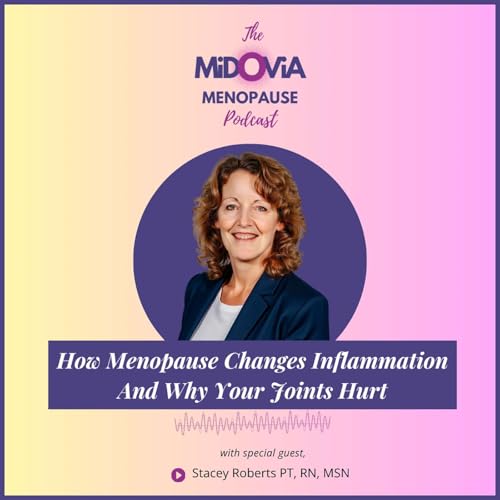
  • Episode 062: How Menopause Changes Inflammation And Why Your Joints Hurt
    Apr 15 2026

    Pain that shows up in midlife has a special way of messing with your confidence. One day you’re fine, the next day your knee, hip, back, or shoulder is changing how you sleep, move, work, and show up for the people you love. We wanted a smarter answer than “that’s just aging,” so we sat down with Stacey Roberts, a longtime physical therapist and chronic pain expert, to talk about what’s actually happening and what you can do next.

    Stacey shares the moment that changed her own thinking: a sudden knee “pop,” a swollen joint, and an appointment that rushed straight to total knee replacement and a cortisone injection. From there, we unpack a key takeaway for anyone dealing with arthritis, joint pain, muscle pain, or chronic pain: imaging does not equal destiny. You can have significant arthritis and still be pain-free, and you can often reduce pain by finding the real drivers instead of chasing a quick fix.

    We also connect the dots to perimenopause and menopause. As estrogen and other hormones decline, you lose natural anti-inflammatory support, which can turn up pain even when your habits haven’t changed. We talk HRT as one possible tool, plus practical lifestyle strategies that matter just as much: reducing ultra-processed foods, checking biomechanics and movement patterns, considering gut health and food sensitivities, and taking stress hormones like cortisol and thyroid function seriously. If you’ve been told to just push through, this conversation offers a different path: curiosity, personalization, and a plan.

    If this helped, subscribe, share the episode with a friend, and leave a review. What’s one pain trigger you’re ready to investigate first?

    Stacey Roberts PT, RN, MSN has over 30 years of experience helping patients live pain-free while achieving their health goals. She is a Holistic Master’s Prepared Registered Nurse, a Musculoskeletal Specialist, a Pelvic and Sexual Health Physiotherapist, and a Functional Medicine Specialist. Stacey owns the New You Health and Wellness Practice in Wauwatosa, Wisconsin, combining cutting-edge technology, advanced manual therapy, and functional medicine to help patients attain optimal health. Many of her patients, including herself have avoided surgery, drugs, and injections. She is the author of the #1 best-selling book, ​​

    The Pain Free Formula: Solving The Puzzle of Muscle and Joint Pain Without Surgery, Drugs, or Injections and the host of the #1 podcast on chronic pain, The Pain Free Formula

    Websites:

    https://newyouhealthandwellness.com

    New You Health and Wellness

    Cozy Earth: www.cozyearth.com

    20% OFF Discount Code: MIDOVIA

    MiDOViA LINKS:

    Website: https://www.midovia.com/
    Instagram: https://www.instagram.com/mymidovia
    LinkedIn: http://www.linkedin.com/midovia
    Email Us: info@midovia.com

    MiDOViA is dedicated to changing the narrative about menopause by educating, raising awareness & supporting women in this stage of life, both at home and in the workplace. Visit midovia.com to learn more.

    The information, including but not limited to, text, graphics, images & other material contained on this website are for informational purposes only. No material on this site is intended to be a substitute for professional medical advice, diagnosis or treatment.

    Show More Show Less
    47 mins
  • Episode 61: Why Libido Changes During Menopause
    Mar 20 2026

    Sex and desire can change in midlife in ways that feel sudden, personal, and isolating. We wanted to pull this topic out of the shadows and put real language around what is actually happening in your body, your brain, and your life. Our guest, Dr. Sarah Berg, is a board-certified OBGYN and certified menopause practitioner known for a direct, honest approach, and she helps us replace shame with clarity.

    We dig into why menopause libido changes are rarely “just hormones.” Dr. Berg breaks down the biology that can make sex uncomfortable including vaginal dryness, tissue changes, pH shifts, and urinary symptoms that raise UTI risk or create fear of leakage. We define genitourinary syndrome of menopause (GSM) in plain terms, explain why it affects the vulva, vagina, urethra, and bladder, and talk through how painful sex can create a lasting pain-tension cycle that takes time to unwind. You will also hear why pelvic floor physical therapy can be a game changer for both function and pleasure, and what to expect if you book an evaluation.

    We also get practical about treatment options and expectations. Dr. Berg explains where vaginal estrogen fits, why it is different from systemic hormone therapy, and why it matters for comfort and UTI prevention. We cover testosterone as a possible tool for carefully selected cases, plus the real first step many women skip: bringing it up with your clinician and asking for time to address sexual health properly. If you are carrying the mental load, running on no sleep, or caring for everyone but yourself, we talk about that too because desire does not thrive in survival mode.

    Dr. Sarah Berg is a board-certified OB-GYN and Certified Menopause Practitioner who spent over a decade caring for women across all life stages. After seeing too many women feel dismissed or confused in midlife, she made it her mission to change that through education.

    She is the founder of Selfority, a science-based women’s health education platform designed to make menopause information accessible, engaging, and empowering. Dr. Berg writes for Katie Couric Media, Parents.com, and Unbiased Science, and is a national speaker known for her honest, direct, and slightly “spicy” approach to women’s health.

    Her work helps women better understand their bodies, advocate for their care, and feel confident navigating the menopause transition.

    Website: https://www.selfority.com/

    Let’s Talk Menopause Menoposium/ Boston: https://www.eventbrite.com/e/lets-talk-menopause-live-boston-ma-tickets

    www.letstalkmenopause.org

    MiDOViA LINKS:

    Website: https://www.midovia.com/
    Instagram: https://www.instagram.com/mymidovia
    LinkedIn: http://www.linkedin.com/midovia
    Email Us: info@midovia.com

    MiDOViA is dedicated to changing the narrative about menopause by educating, raising awareness & supporting women in this stage of life, both at home and in the workplace. Visit midovia.com to learn more.

    The information, including but not limited to, text, graphics, images & other material contained on this website are for informational purposes only. No material on this site is intended to be a substitute for professional medical advice, diagnosis or treatment.

    Show More Show Less
    42 mins
  • Episode 60: Hormones And Hidden Neurodivergence
    Mar 12 2026

    Menopause can feel like you woke up in a different brain, but what if the real story is that your brain has always worked this way and hormones are simply turning up the volume? We sit down with leadership coach and R.E.A.L Women founder Chellie Adler to talk about the often-missed link between perimenopause, menopause, and neurodivergence, especially ADHD in women and autism in women who were never identified in childhood.

    We dig into what happens when estrogen shifts disrupt dopamine regulation and executive functioning, why your carefully built “scaffolding” of coping tools can suddenly collapse, and how that can show up as distractibility, emotional reactivity, sensory overload, and the infamous string of “side quests” that derails the day. Chellie also explains why many women finally recognize the pattern when their kids get evaluated, and how to think about screening tools like the Adult ADHD Self-Report Scale (ASRS) as a starting point rather than a diagnosis.

    From there, we zoom out to the workplace: masking fatigue, burnout, and why so many experienced midlife women leave roles they’re actually great at. We talk practical supports for individuals (qualified evaluation, therapy with ADHD/autism training, medication options, executive function support, and how hormone therapy may help some women) and concrete accommodations employers can make, from lighting and temperature to benefits and culture.

    If this conversation hits home, share it with a friend, subscribe for more, and leave a review so more women can find the support and language they’ve been missing. What’s one change that would make your workday easier right now?

    Chellie is a Licensed Professional Counselor (LPC) who specializes in supporting women navigating ADHD and AuDHD, particularly those who have spent years feeling overlooked or misunderstood while appearing “fine” on the outside. Her work focuses on helping women better understand their brains through a neurodivergent-affirming lens so they feel validated, empowered, and supported.

    At Everlasting Wellness LLC, Chellie provides ADHD assessments and therapy using a trauma-informed, client-centered approach. She integrates cognitive behavioral therapy, executive functioning skill-building, and practical strategies to help clients manage anxiety, burnout, perfectionism, and major life transitions.

    Earlier in her career, Chellie worked across multiple areas of human services in New York, including at-risk youth, geriatric mental health, community colleges, and DOJ/OMH collaborations. Today, she is especially passionate about helping high-achieving individuals who carry significant responsibilities yet feel stretched thin find clarity, resilience, and sustainable ways to thrive.

    Website: https://www.kristinswansonconsulting.com/

    MiDOViA LINKS:

    Website: https://www.midovia.com/
    Instagram: https://www.instagram.com/mymidovia
    LinkedIn: http://www.linkedin.com/midovia
    Email Us: info@midovia.com

    MiDOViA is dedicated to changing the narrative about menopause by educating, raising awareness & supporting women in this stage of life, both at home and in the workplace. Visit midovia.com to learn more.

    The information, including but not limited to, text, graphics, images & other material contained on this website are for informational purposes only. No material on this site is intended to be a substitute for professional medical advice, diagnosis or treatment.

    Show More Show Less
    48 mins