The TWIML AI Podcast (formerly This Week in Machine Learning & Artificial Intelligence) cover art

The TWIML AI Podcast (formerly This Week in Machine Learning & Artificial Intelligence)

The TWIML AI Podcast (formerly This Week in Machine Learning & Artificial Intelligence)

By: Sam Charrington
Listen for free

Machine learning and artificial intelligence are dramatically changing the way businesses operate and people live. The TWIML AI Podcast brings the top minds and ideas from the world of ML and AI to a broad and influential community of ML/AI researchers, data scientists, engineers and tech-savvy business and IT leaders. Hosted by Sam Charrington, a sought after industry analyst, speaker, commentator and thought leader. Technologies covered include machine learning, artificial intelligence, deep learning, natural language processing, neural networks, analytics, computer science, data science and more.All rights reserved Politics & Government Science
Episodes
  • Why AI Agents Break the GenAI Security Model with Devvret Rishi - #770
    Jun 16 2026
    In this episode, Sam talks with Dev Rishi, GM of AI at Rubrik, about what happens when agents move beyond answering questions and start taking action across tools, systems, and business processes. We explore why the enterprise playbook of static guardrails plus human approval starts to break down in the agent era. Agents are useful because they can plan, call tools, update systems, write code, send messages, and operate across workflows at machine speed, but those same capabilities make them difficult to govern with rules written in advance or approval prompts reviewed one at a time. Dev explains why tool access increases blast radius, why agents can route around controls in surprising ways, and why human-in-the-loop review can become security theater when agents operate at scale. We also discuss what enterprises need instead: better visibility, runtime enforcement, policy-aware governance, agent observability, and recovery mechanisms for when something goes wrong. Along the way, we dig into MCP and tool sprawl, small language models for policy enforcement, defense in depth, agent rewind, and why AI may be needed to help secure AI. 🗒️ Full show notes: https://twimlai.com/go/770.
    Show More Show Less
    56 mins
  • Is RAG Dead? Lessons from Building AI for Tax Law with Alex Bowcut - #769
    Jun 9 2026
    As context windows grow into the millions of tokens, many AI practitioners are questioning whether retrieval-augmented generation (RAG) is still necessary. If modern models can ingest entire libraries of documents, why bother with retrieval at all? In this episode, Alex Bowcut, Head of Engineering at Sphere, explains why the answer depends on the application. Sphere uses AI to automate global tax compliance—an environment where getting the answer right isn’t enough. Every conclusion must be backed by the correct legal citation, and every decision must withstand expert review. We explore how Sphere built TRAM (Tax Review and Assessment Model), a production AI system that combines retrieval, reasoning models, legal review workflows, reinforcement learning, and deterministic systems to help tax experts move nearly two orders of magnitude faster while maintaining accuracy. Along the way, we discuss why RAG remains critical in high-stakes domains, how Sphere processes legal and regulatory documents from jurisdictions around the world, retrieval architectures, semantic chunking, dense versus sparse retrieval, expert feedback loops, and the challenges of building AI systems that people can actually trust. 🗒️ Full show notes: https://twimlai.com/go/769.
    Show More Show Less
    52 mins
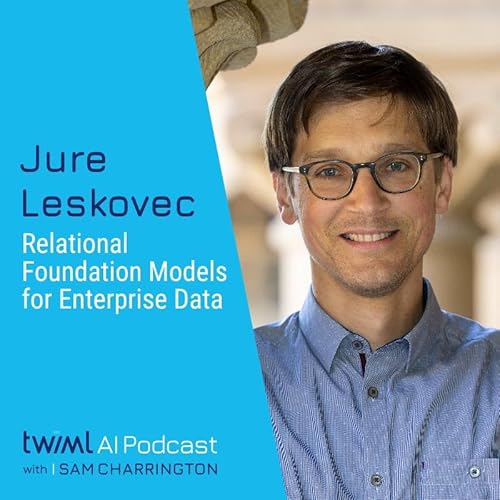
  • Relational Foundation Models for Enterprise Data with Jure Leskovec - #768
    May 21 2026
    In this episode, Jure Leskovec, co-founder and chief scientist at Kumo and professor of computer science at Stanford, joins us to explore two fronts of his work: AI for science and relational deep learning. We begin with AI Virtual Cell, a multiscale effort to learn data-driven representations from proteins to cells to patients using single-cell RNA-seq data, protein language models like ESM, and structure models like AlphaFold—without hand-encoding biology. Jure then dives into relational deep learning, reframing enterprise databases as graphs and training neural networks directly on raw multi-table data. He explains Kumo’s Relational Foundation Model (RFM2), which performs in-context learning over subgraphs to make accurate predictions on new databases and tasks with no training, and how this approach benchmarks against RelBench and other multi-table datasets. We also discuss real-world deployments at companies like Reddit, DoorDash, and Coinbase, explainability via attention over tables and columns, integration with agentic systems, deployment options, and practical limitations. The complete show notes for this episode can be found at https://twimlai.com/go/768.
    Show More Show Less
    1 hr and 6 mins
adbl_web_anon_alc_button_suppression_t1
All stars
Most relevant
Love these shows. Informative and well put together and I always leave a little bit more informed 😬

My favourite AI podcast

Something went wrong. Please try again in a few minutes.