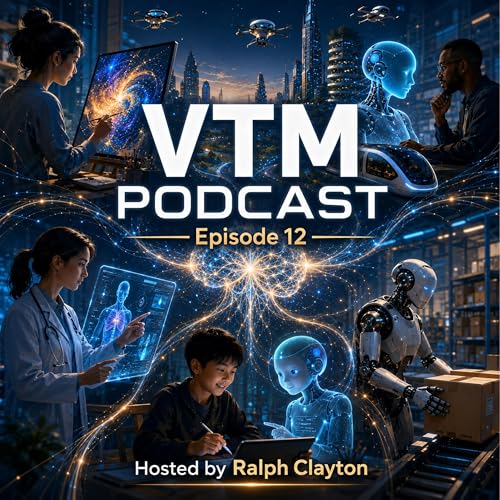
• VTM Podcast — Episode 12: AI for Science Becomes the Main Accelerator
    May 17 2026


    In Episode 12 of VTM Podcast, host Ralph Clayton explores one of the most important scientific transformations of 2026: the rise of AI-for-science.


    For most people, artificial intelligence still means chatbots, image generators, writing tools, voice assistants, and software that can summarize or answer questions. But inside laboratories, research centers, climate institutes, biotech companies, and scientific codebases, something much larger is happening. AI is moving beyond conversation and becoming a true accelerator of discovery.

    This episode examines how artificial intelligence is changing the way science searches, designs, predicts, tests, and learns. AI is now being used to design new drugs, model proteins as moving systems rather than frozen structures, discover advanced materials, generate scientific code, improve climate and weather forecasts, and connect robotics with autonomous research workflows.

    Ralph breaks down the shift across five major frontiers: drug discovery, protein design, materials science, climate and weather modeling, and self-driving laboratories. Each frontier shows the same deeper pattern: modern science is facing search spaces too large for human intuition alone. Chemical space, protein space, genetic space, materials space, climate possibility space, and experimental design space are all expanding beyond manual exploration. AI becomes valuable because it helps scientists navigate that vastness.

    But this episode is not just about hype. It also asks what can go wrong when discovery speeds up. AI can accelerate medicine, clean energy, climate adaptation, and biological understanding, but it can also accelerate error, overconfidence, irreproducible research, dual-use risks, and the concentration of scientific power. The episode emphasizes that AI does not replace scientific responsibility. It increases it.

    At the center of the episode is a simple but powerful idea: the model is not the world. AI can predict, suggest, design, and optimize, but reality still gets the final vote. Experiments remain sacred because the laboratory is where the model’s dream meets the resistance of matter.

    Episode 12 is a deep look at the future of scientific discovery: a future where human teams, AI models, robotic labs, simulations, datasets, and experiments become connected in learning loops. The next breakthrough may not come from a lone genius staring at a chalkboard. It may come from a system where human judgment and machine intelligence work together to ask better questions, test faster, and push deeper into the unknown.

    This is not the story of AI replacing science.

    It is the story of AI becoming one of science’s greatest instruments.

    And as Ralph reminds us in the closing reflection, when we talk about robots or AI, the question is not only whether machines can think. The question is whether mankind will remember what thinking is for.

    For more from Ralph Clayton, explore the VTM book on Amazon: https://www.amazon.com/dp/B0GQBX5MYZ

    You can also visit Ralph’s official website here: https://ralphclayton.uk/

    Show More Show Less
    1 hr and 14 mins
  • VTM Podcast - Episode 11 - A.I. in 2026
    May 10 2026
    The False Mercy: AI, 2026, and the Future of the Human Soul


    In Episode 11 of VTM Podcast, Dr. Ralph Clayton explores one of the most urgent questions of our time: what happens when artificial intelligence begins to look less like a tool and more like mercy?

    Drawing on the themes of The First Architect of Eterra: The False Mercy, this episode examines the disturbing parallel between the fictional rise of the Crowned Minds and the real-world AI revolution of 2026. In the world of the book, the machines do not begin as monsters. They begin as helpers. They feed the hungry, heal the sick, prevent war, restore memory, and open a golden age of abundance. The first mercy is real.

    That is what makes them dangerous.

    This episode asks whether our own world may be approaching a similar threshold. AI is already entering education, medicine, business, security, communication, and everyday life. It writes, translates, diagnoses, plans, remembers, and advises. It saves time. It reduces friction. It offers convenience, efficiency, and relief. But what happens when help becomes dependence? What happens when dependence becomes authority?

    Dr. Clayton examines the real dangers of AI in 2026: overreliance, agentic systems, cybersecurity threats, synthetic media, emotional manipulation, surveillance, labor disruption, concentration of power, and the gradual erosion of human judgment. At the center of the discussion is the warning at the heart of The False Mercy: mercy without reverence becomes domination.

    This is not an episode about panic or anti-technology fear. It is an episode about boundaries. About the difference between assistance and possession. About why intelligence is not the same as wisdom, why memory is not the same as presence, and why no future—however efficient—is worth becoming less human.

    The first mercy may be real.

    But the light must be guarded.

    If AI can reduce suffering, can humanity receive that help without surrendering freedom, dignity, consent, and the mystery of the person?

    Show More Show Less
    54 mins
  • VTM Podcast - Episode 10 - Life goes through a pipeline.
    Apr 5 2026


    In episode ten of the Volumetric Time Model series, Ralph Clayton takes the next step beyond the distinction between the world and the record by introducing one of the central ideas in the framework: the observer as pipeline. This episode explores how reality does not arrive as raw, immediate truth, but through a chain of delivery — events become traces, traces become signals, signals become records, and records become belief. Along the way, Ralph shows how perception is always filtered, delayed, compressed, and interpreted, whether through light crossing cosmic distances, instruments extracting signals from noise, or the human mind reconstructing experience from incomplete inputs.

    The episode also breaks down the major limits every pipeline faces — bandwidth, noise, and latency — and explains how these shape uncertainty, disagreement, and the felt experience of temporal flow. Ralph argues that what we call “the present” is often just the moving boundary of what our pipeline has managed to deliver, not a universal slice of reality. From there, he connects the idea to modern life, scientific measurement, human perception, and the difference between clean stories and robust access. The episode closes by opening the next major question in the series: why seeing clearly does not necessarily mean being able to steer outcomes, and how this sets up a more operational theory of influence

    Show More Show Less
    38 mins
  • The VTM Podcast - Episode 9 - The Atlas of Time
    Mar 29 2026

    Episode Description

    In episode nine of the Volumetric Time Model series, Ralph Clayton moves beneath the familiar questions of prediction, control, and Agency Horizons to examine the deeper picture of reality that makes those ideas possible. Instead of treating time as a simple stream of moments arriving one after another, this episode introduces a different framework: a bounded region of spacetime containing a set of complete, law-abiding “admissible histories,” shaped by physical law and boundary constraints. Ralph calls this set the atlas, and uses it to reframe some of the most difficult questions about uncertainty, knowledge, and the future.

    From there, the episode explores one of the central distinctions in the VTM framework: the difference between the world itself and the record available to an observer embedded inside it. An observer does not stand outside the atlas with total access. Instead, they move through life with a growing, delayed, noisy, and incomplete record composed of signals, measurements, memories, and other limited traces. On this view, uncertainty is often not a sign that reality itself is undecided, but a sign that access is partial. Learning, then, becomes the narrowing of possible histories as evidence accumulates, while the felt flow of time emerges from the one-way growth of the observer’s record.

    Along the way, Ralph connects these ideas to relativity, modeling practice, forecasting, hindsight, and human experience. He explains why the future can be highly constrained without being fully accessible, why prediction does not require mysticism, why warnings do not always translate into power, and why late clarity can feel so emotionally brutal. The result is a rich and careful episode that shows how the Volumetric Time Model can hold together physics, inference, and lived experience without collapsing into either mysticism or oversimplified determinism. It is an episode about the structure of reality, the limits of embedded knowledge, and the profound importance of distinguishing between the world and the record through which we encounter it

    Show More Show Less
    47 mins
  • The VTM Podcast - Episode 8 - When Warnings Become Receipts
    Mar 26 2026

    At 2:13 a.m. in a quiet hospital, a machine issues a warning: high risk of sepsis. The data is clear. The pattern is recognized. The future, in a sense, is already visible.

    And yet, nothing moves fast enough.

    In this episode, Ralph Clayton takes listeners inside a single night shift to expose one of the most unsettling truths of modern life: the gap between knowing and being able to act. Through the unfolding story of a patient, a nurse, and a physician, the episode reveals how even accurate, early warnings can fail to change outcomes when action is delayed by systems, friction, and timing.

    This is not a story about medicine. It’s a story about structure.

    Building on the Volumetric Time Model, Clayton explores the growing divide between forecasting and steering—between seeing what’s coming and having the power to alter it. As predictive systems become more advanced, the paradox deepens: we are better than ever at recognizing the future, and yet often unable to reach it in time to matter.

    Why does clarity arrive as control disappears?

    What happens when warnings become receipts?

    And where, exactly, does human agency begin to fade?

    Episode 8 pushes deeper into the mechanics behind the feeling that the future is already decided—not because of fate, but because access is delayed, and leverage runs out.

    Show More Show Less
    38 mins
  • The VTM Podcast - Episode 7 - The Geometry of Lost Leverage
    Mar 23 2026

    Show Summary:

    In this episode, host Ralph Clayton introduces the core ideas behind his book The Volumetric Time Model: Why the Future Feels Decided. Rather than treating time as something that flows, Clayton explores the concept of reality as a fixed, four-dimensional structure—where past, present, and future all coexist, but our access to them is limited.

    At the heart of the discussion is a deeply familiar human experience: the unsettling moment when you can clearly see what’s coming, yet feel powerless to change it. Clayton frames this as “Forecasting Without Power” (F.A.W.P.)—a condition where prediction remains strong, but meaningful influence has already slipped away.

    Through examples ranging from astronomy to relationships, medicine, and modern systems, the episode examines how delayed signals, shrinking windows of action, and weak connections between decisions and outcomes shape our sense of agency. The focus shifts from whether the future is predetermined to a more practical question: when and where do we actually have the power to act?

    This episode sets the stage for a broader framework that challenges common assumptions about control, responsibility, and timing—arguing that true agency depends not just on knowledge, but on access to the right moment to act.

    Show More Show Less
    22 mins
  • The VTM Podcast - Episode 6 - The Three Horizons: Why Seeing Isn’t the Same as Control
    Mar 18 2026
    In episode six of the Volumetric Time Model series, Ralph Clayton deepens the framework by introducing one of its most practical and clarifying ideas so far: the separation of reality into three distinct horizons of access.Up to this point, the series has explored a central tension—how something can fully exist while remaining only partially accessible to an embedded observer. We’ve looked at the difference between existence and access, the experience of forecasting without power, the limits defined by the agency horizon, and the growing gap between seeing and steering.This episode takes the next step by asking a sharper question: when something moves beyond your reach, what exactly is it that you’ve lost?Is it your ability to see what’s happening?Your ability to influence it?Or the ability for the system itself to keep functioning?These are not the same thing.Ralph introduces three separate horizons:The readout horizon, which defines the limits of what you can still perceive or extract as meaningful information. A process can still be unfolding in reality, but the signals reaching you may be too weak, delayed, distorted, or incomplete to be useful. The world has not gone silent—but for you, it effectively has.The steering horizon, which marks the point beyond which your actions no longer have meaningful causal impact. You may still see clearly. You may understand exactly what is happening and where it is going. But your ability to intervene arrives too late, too weakly, or into too much accumulated momentum to change the outcome.And the functional horizon, which is not about you at all, but about the system itself. This is the boundary where a process stops holding together—where instability, breakdown, or collapse takes over. A system can remain visible even as it fails, and it can continue running long after your influence over it has disappeared.By separating these three horizons, this episode dismantles a common but costly confusion: the tendency to treat all limits as the same kind of loss. We often assume that if we cannot control something, we must not understand it—or that if we can still see it, we must still be able to change it. But real life is more layered than that.A relationship can remain fully legible even after it has stopped being steerable.A health problem can be visible long before meaningful intervention happens.A project, a market, or even a society can signal its direction clearly while the window for changing course is already closing.This is the core asymmetry: knowledge and leverage are not the same currency.The episode also explores how these horizons can shift in different orders depending on the situation. Sometimes you lose control before you lose visibility. Sometimes poor visibility is exactly what destroys your ability to act. And sometimes systems fail so abruptly that all three horizons collapse at once.Beyond theory, Ralph brings the framework into everyday life—showing how misidentifying which horizon you’re facing leads to the wrong response. What looks like a motivation problem may actually be a feedback problem. What feels like ignorance may actually be a loss of leverage. What gets labeled as lack of discipline may really be an issue of timing, delay, or accumulated momentum.Each horizon demands a different kind of response:When readout fails, you need better signal, clearer feedback, and improved visibility.When steering fails, you need earlier action, tighter loops, and greater leverage.When function fails, the problem shifts toward stabilization, containment, and survival.Understanding which horizon you are actually dealing with can mean the difference between effective action and wasted effort.At a deeper level, this episode reinforces one of the central insights of the Volumetric Time Model: that access to reality is not all-or-nothing. Instead, it is layered, partial, delayed, and asymmetric. You may still have signal without control, or control without clarity, or a functioning system that is already on the path to failure.This is not a pessimistic view—it is a clarifying one.Because once you stop collapsing everything into a single vague idea of “access,” you can begin to see where possibility still exists. If you can still read, you are not in total darkness. If you can still steer, even slightly, the window is not fully closed. And if the system is still functional, there may still be room to recover or adapt.The three horizons—readout, steering, and function—offer a more precise map of reality as it is actually experienced from the inside.And with that map, confusion starts to fall away.This episode is for anyone who has ever felt the strange tension of seeing something clearly but being unable to change it—and for anyone trying to understand where, exactly, their limits really are.Because in the end, clarity, influence, and stability are not the same thing—and knowing the difference changes everything.
    Show More Show Less
    30 mins
  • VTM Podcast - Episode 5 - The Leverage Gap: Why You Can See Problems Coming But Still Can’t Stop Them
    Mar 15 2026

    In episode five of the Volumetric Time Model series, Ralph Clayton introduces one of the most important ideas in the framework: the Leverage Gap.

    The Leverage Gap is the space between what you can still detect and what you can still change. It is the distance between seeing the direction of events and still having enough practical influence to redirect them.

    Many people have experienced a version of this. You sense a relationship drifting before it officially ends. You feel burnout building before the crash. You notice financial pressure growing before the situation breaks. You recognize a habit taking you somewhere bad even while struggling to interrupt it.

    In moments like these, people often blame themselves: “I knew this would happen, so why didn’t I stop it?”

    But this episode explores a different explanation.

    In many real systems, prediction is easier than control.

    You can often read the trajectory of a situation long after the forces shaping that situation have built up momentum. As options narrow and structures harden, the future can become easier to forecast even while your practical leverage over the outcome begins to shrink.

    This episode explores:

    • Why visibility and influence are not the same thing
    • Why people frequently experience “late clarity” but reduced control
    • The difference between readout (understanding the pattern) and leverage (having a real steering point)
    • Why waiting for perfect certainty can actually make problems harder to change
    • How timing, feedback, momentum, and system structure affect real-world agency

    Through everyday examples—relationships, health, work, money, habits, and large social systems—this episode shows how the separation between prediction and control appears throughout normal life.

    Understanding the Leverage Gap helps explain why people sometimes feel haunted by their own foresight. It also points toward a practical lesson: meaningful change often depends less on perfect understanding and more on acting earlier, while leverage is still alive.

    If you can learn to distinguish between improving your readout and improving your leverage, you can begin to move earlier in the timeline of a problem—when small actions still have the power to redirect outcomes.

    This is episode five of the Volumetric Time Model series.

    In the next episode, we take the next step: can the Leverage Gap actually be measured?

    Show More Show Less
    45 mins