• Part 5: The Yoga Systems & Functional Application
    Jul 13 2026

    Part 5: The Yoga Systems & Functional ApplicationThe series culminates with a focus on Yogas, or planetary combinations that "yoke" a person to their destiny. It teaches how to identify functional benefics and malefics for specific rising signs and introduces the D.A.R.E.S. framework to categorize major chart combinations like Rajyogas and Arishta Yogas. Listeners will learn about prestigious alignments like the Panchmahapurush Yogas, the paradoxical Vipreet Rajyogas, and the specific conditions required for Neechbhanga Raj Yoga (the cancellation of debilitation)

    Show More Show Less
    50 mins
  • Part 4: The prediction Framework: Placement, Aspect and Conjunction
    Jul 11 2026

    Adopted as an investigative masterclass, this overview deconstructs the "rules of engagement" between planets. It explains how planets gain or lose strength through Exaltation, Debilitation, and Combustion. Key systems highlighted include the Five-Fold Friendship (Panchda-maitri)—which synthesizes permanent natural relationships with situational temporal ones—and the P.A.C. (Placement, Aspect, Conjunction) framework. It also details Planetary Aspects (Drishti), particularly the special full aspects of Mars, Saturn, and Jupiter

    Show More Show Less
    51 mins
  • Part3: Nakshatras and Anatomy of Nine Planets
    Jul 4 2026

    Welcome to the third chapter of our deep-dive series: Part 3: Nakshatras & The Anatomy of Nine Planets. In this segment, we peel back the layers of the zodiac to reveal the intricate stellar backdrop of the 27 Nakshatras, or lunar mansions. You will learn how these 27 divisions provide a much finer resolution than signs alone, with each sign containing exactly nine padas that determine the starting point of an individual’s Vimshottari Dasha.

    We then shift our focus to the nine planets (Grahas), treating them not just as celestial bodies, but as living archetypes with distinct personalities and physical forms. From the Sun, the majestic significator of the soul and authority, to the mysterious and introverted shadow node Ketu, we explore the psychological and physical profiles that define each planetary force.

    Finally, we delve into the exhaustive classification matrix that connects these planets to every facet of existence. We will discuss their ruling deities, their cosmic Gunas (Sattva, Rajas, Tamas), and their influence on physical health through the Ayurvedic Tridoshas. We even explore the spiritual connection between the planets and the 10 Avatars of Vishnu, such as the Sun’s link to Lord Ram and the Moon’s connection to Lord Krishna. Get ready to see the planets as the true ministers and forces of the cosmic government.

    Show More Show Less
    36 mins
  • Part 2: The Ascendant and Sign Anatomy
    Jul 4 2026

    Welcome to the second segment of our deep-dive review: Part 2: The Ascendant & Sign Anatomy. In this section, we move from the general layout of the zodiac to the specific "lens" through which an individual's life is viewed—the Ascendant, or Lagna.

    We begin by exploring the astronomical significance of the Lagna as the sign rising on the eastern horizon at the moment of birth. Because the Earth rotates, this rising sign changes approximately every two hours, meaning that even people born on the same day can have vastly different life paths. This review brings the 12 zodiac signs to life, detailing the specific physical archetypes and personality traits associated with each—from the muscular and impulsive nature of Aries to the intellectual and communicative spirit of Gemini.

    Beyond personality, we delve into the "anatomy" of the signs by mapping them to specific body parts—such as Aries ruling the head and Pisces ruling the feet—and geographical environments, like the hills of Virgo or the deep waters of Aquarius. Finally, we examine the deeper structural attributes of the signs, including their elements (Fire, Earth, Air, Water), directions, and Bali, which determines whether a sign is naturally stronger during the day or night.

    Show More Show Less
    48 mins
  • Part 1: The Cosmic Canvas- Navigating 12 houses in Vedic Astrology
    Jul 4 2026

    Welcome to the introductory deep dive into Part 1: The Cosmic Canvas & The 12 Houses. This segment explores the foundational geometry of Vedic astrology, beginning with the Bhachakra, a 360-degree zodiac belt divided into 12 signs of 30 degrees each.

    In this review, we examine the three primary horoscopic forms used to visualize the heavens: the North Indian style with its movable houses, the South Indian fixed-sign layout, and the regional East Indian style. You will learn how to identify the 12 zodiac signs through their symbolic archetypes—from the fiery Aries (Ram) to the spiritual Pisces (Fishes)—and their respective planetary lords.

    Finally, we map out the 12 Houses (Bhavas), which serve as the blueprint for an individual's life. We will cover everything from the 1st House (Tanu Bhav), representing one's physical appearance and personality, to the 12th House (Vyay Bhav), governing expenses and seclusion. We also break down critical structural classifications like the foundational Kendras (Quadrants) and the goal-oriented Trikon groups.

    Show More Show Less
    52 mins
  • Vedic Astrology Divisional Charts (D10, D12, D30) Foundation Guide Part 2
    Jul 2 2026

    The Dashamsha (D-10) is the vital chart for evaluating professional achievements, status, and career success, dividing each sign into ten 3° segments to assess a native's earned income and professional growth. For family roots, the Dwadashamsha (D-12) focuses specifically on parents and provides a link to past and future lives; it divides signs into twelve 2°30' parts where the count begins from the sign itself. Finally, the Trimshamsha (D-30) is utilized to diagnose misfortunes, character, and "arishta" (inauspiciousness). It mathematically divides each sign into thirty 1° divisions, though rulership is grouped into five planetary sectors—Mars, Saturn, Jupiter, Mercury, and Venus—with the Sun and Moon excluded from ownership.


    Show More Show Less
    42 mins
  • Vedic Astrology Divisional Charts (D2,D3,D7,D9) Foundation Guide Part 1
    Jul 2 2026

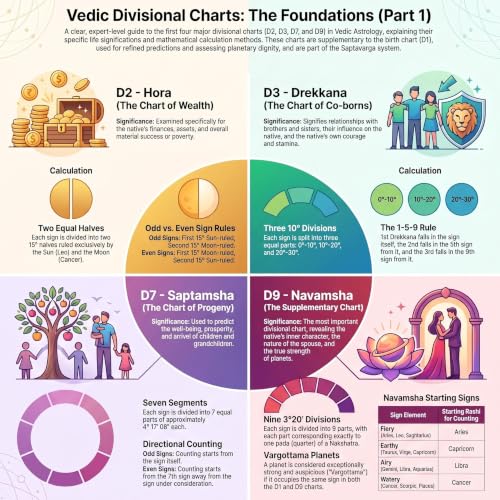
    Divisional charts, or Vargas, are essential tools in Hindu astrology for refining the analysis of specific life domains. The Hora (D-2) chart focuses on wealth and prosperity; it divides each sign into two 15° segments ruled by the Sun and Moon based on whether the sign is odd or even. The Drekkana (D-3) chart represents siblings and co-borns, dividing signs into three 10° parts where placements map to the sign itself, the 5th, or the 9th sign from the original.

    For matters of progeny and grandchildren, the Saptamsha (D-7) is consulted. It divides a sign into seven parts of approximately 4°17', with counting starting from the sign itself for odd signs and from the 7th sign for even signs. Finally, the Navamsha (D-9) is the most vital divisional chart, used to judge planetary strength and married life. It consists of nine 3°20' divisions where placements are determined by the sign’s element. A planet occupying the same sign in both the Rashi and Navamsha is Vargottama, indicating exceptional stability.

    Show More Show Less
    46 mins
  • Mercury-The Scandalous Cosmic Birth of Intelligence
    Jun 28 2026

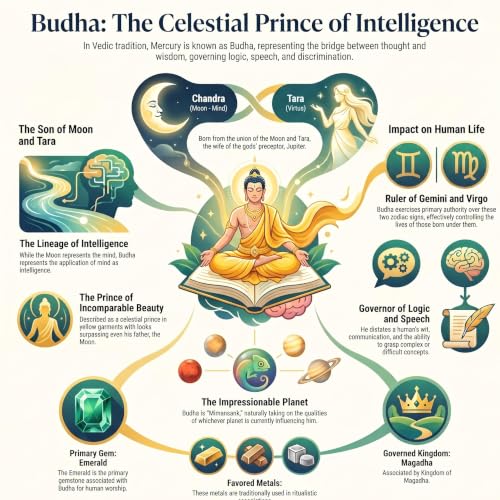
    Mercury, known as Budha, is the celestial prince representing intelligence, born from the controversial union between the Moon (Mind) and Tara, the wife of Jupiter (Wisdom).

    He is the initiator of the Chandravansh (Lunar Dynasty) through his son Puruava, yet is astrologically treated as an eunuch and linked to impotence.

    Governing logic, discrimination, wit, and speech, he is referred to as a "Mimansank"—someone capable of grasping and explaining complex points with ease.

    His nature is highly impressionable, causing him to adopt the characteristics of whichever planet is influencing him at the time.

    He treats the Moon as an enemy because intelligence is wary of the mind's quick-acting instability, while remaining neutral to Jupiter and a friend to Venus.

    He is described as having incomparable beauty and a dark blue complexion resembling a Priyangu bud

    Show More Show Less
    33 mins